Quick Answer:
Bridal makeup photos show how the eyes, lips, skin finish and styling read together in that particular image. Compare a whole-look view with a closer portrait, then use the bride's brief or trial story to understand the choices behind it. A photograph alone cannot establish the products used, editing history, comfort or wear time.
You save one bridal photograph for the eyes, another for the lip color, and a third for the whole look. Then you try to compare the artists behind them. The pictures are useful, but they do not all answer the same question.
I would rather you bring a photograph with a specific question than feel you have to judge an entire artist from one image. Here is how to read what is there, recognize what is missing, and use that difference when discussing your own makeup.
Start with the detail you want to understand
What bridal makeup photos show depends partly on how much of the face you can actually see. A full-length portrait helps you read the saree, hair, jewelry and face together. It cannot give you the same information as a closer view of the eyes or the edge of the base.
Be precise about what made you save it. Was it the depth around the eyes? The lip against the saree? The way a defined face still sits comfortably within traditional styling? That gives the artist something useful to discuss. Saying only that you want the same makeup leaves too much open.
Our bridal makeup approach starts with the person wearing the look. A reference can help explain your taste without becoming a promise that your face, features and wedding setting will look identical.
Read the whole look in Shruthi's photographs
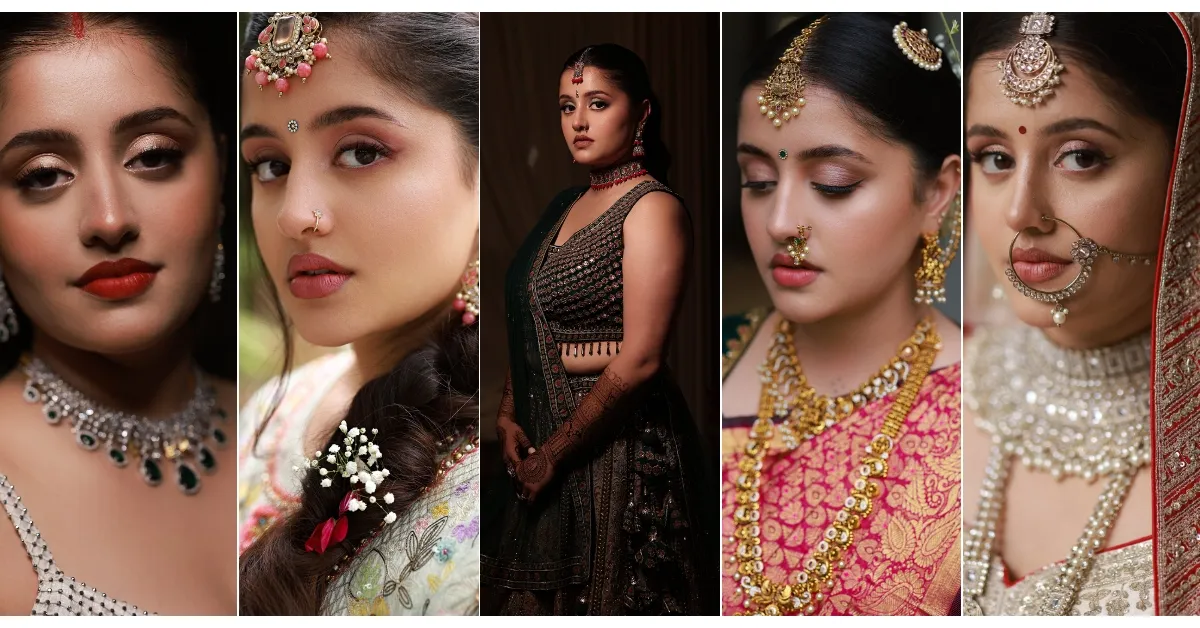
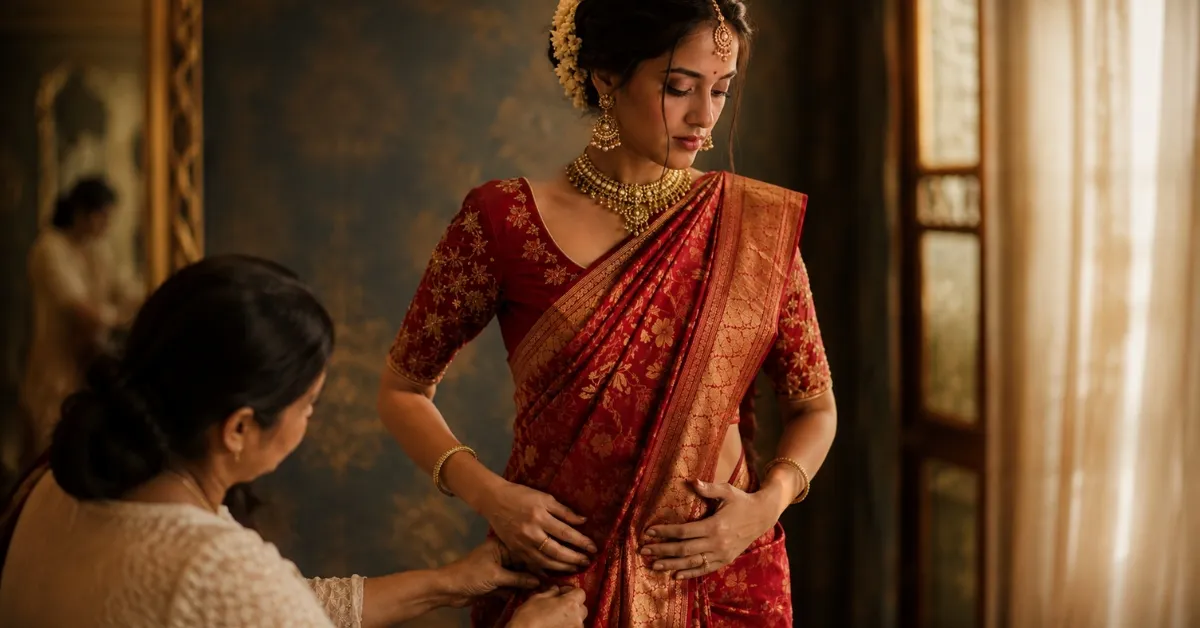
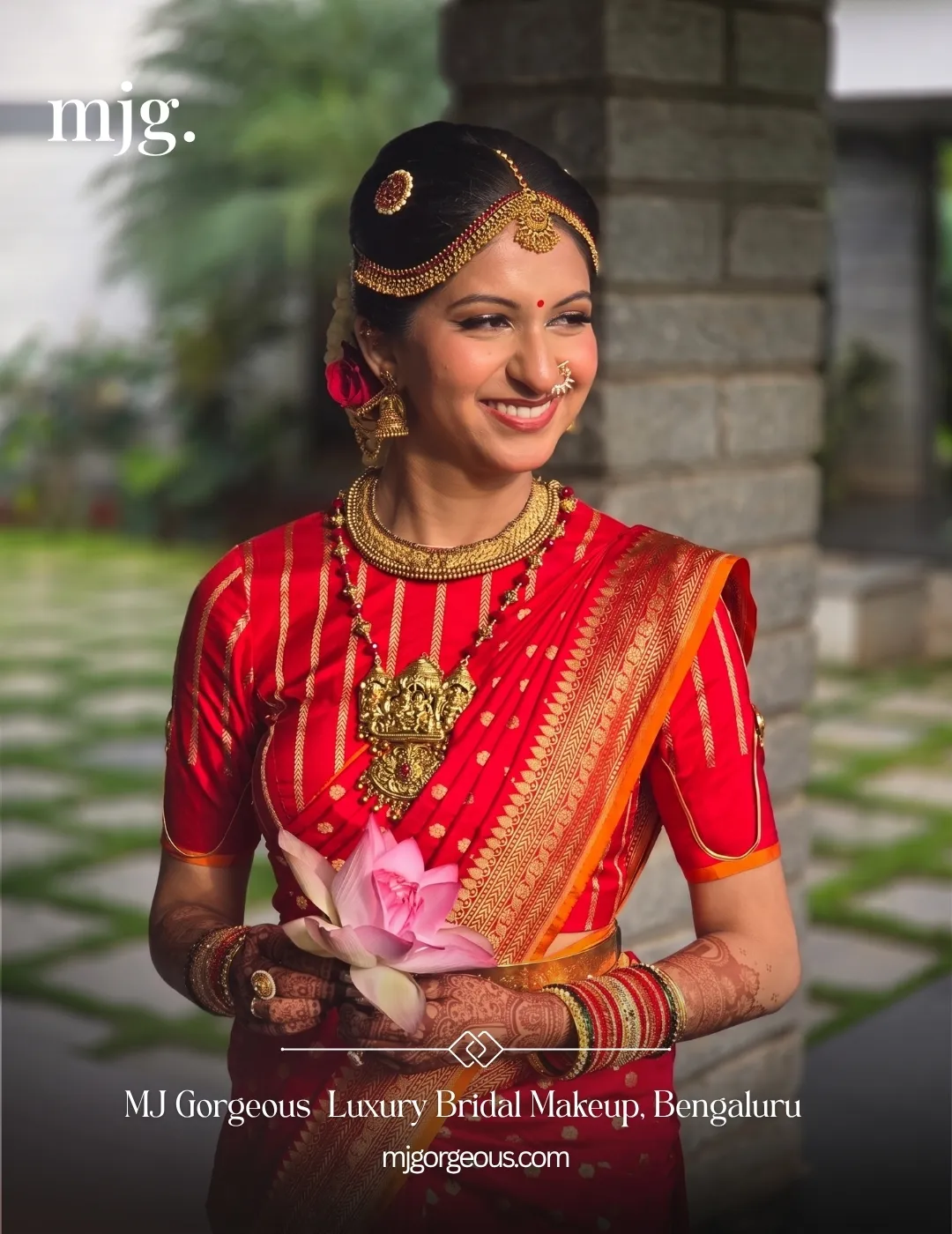
Shruthi's full-length photograph is useful for judging the whole bridal arrangement. The red lip echoes the red in her saree and blouse, while the defined eyes remain visible beside the gold jewelry. Her raised arms and long braid also make this a styling reference, not just a picture of a face.
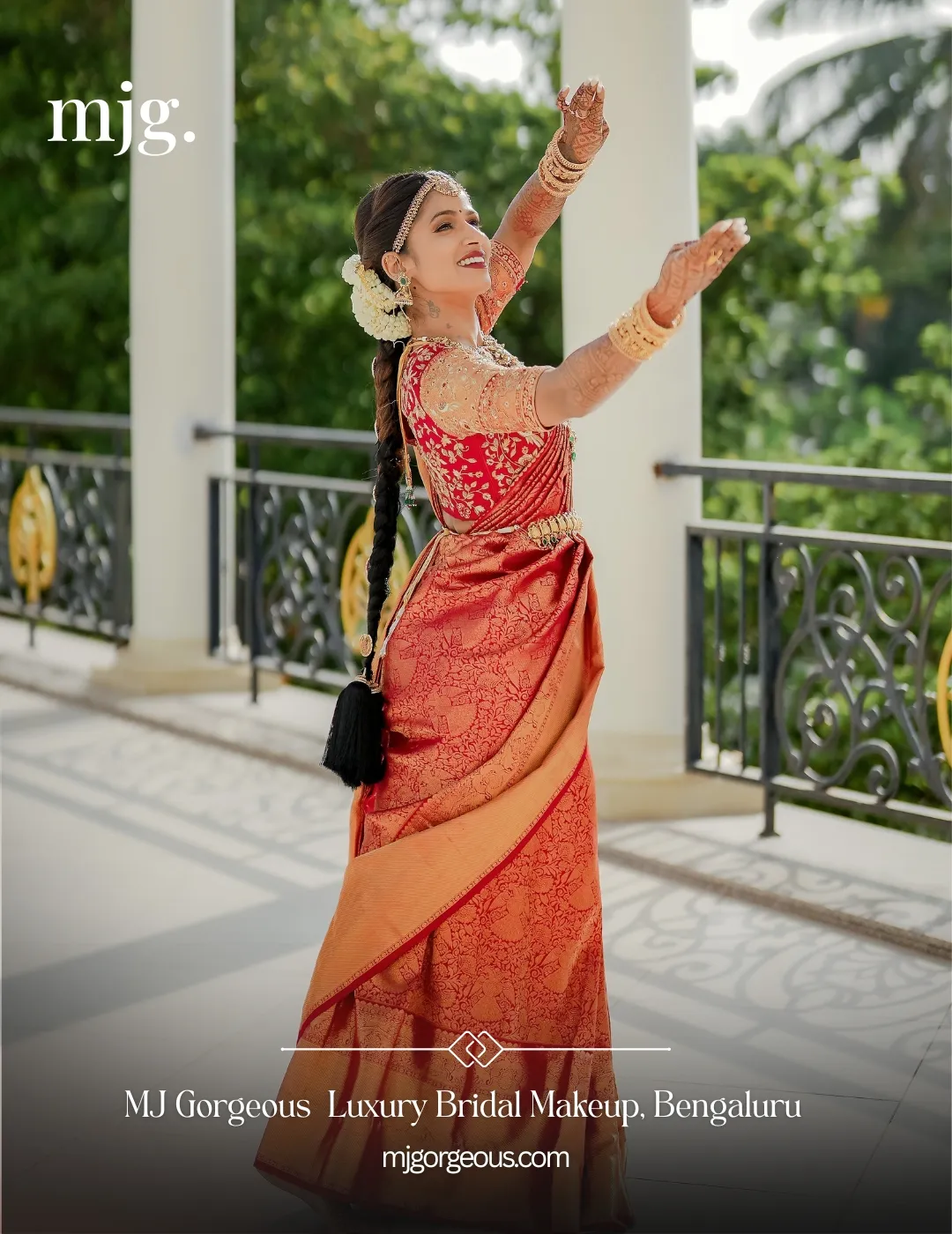
Shruthi's full-length view brings the red-and-gold saree, jewelry, flowers, braid and makeup into one frame.
Her published bridal story adds the part a photograph cannot explain. Shruthi was a Kathak dancer who wanted sharp, glamorous makeup that still felt traditional, without carrying her stage identity into the wedding. I chose an airbrush base and detailed eye makeup within that brief.
Read that brief alongside the picture. Sharp definition did not have to mean repeating stage makeup. Here, the face is one part of a strongly colored, ornamented look. For a bride choosing similar traditional styling, the useful comparison is whether she likes that level of definition with the saree and jewelry, not whether the makeup looks dramatic in isolation.
Try covering the lower half of the picture for a moment, then look at the full frame again. Notice how much information the drape, braid and jewelry add to your judgment. If you like the whole arrangement but not the lip color, separate those preferences before saving it as your reference. The published story supplies the airbrush detail; a smooth-looking face alone would not identify that technique.
A useful question here would be: I like the definition with this traditional styling. How would you adapt that balance to my features and saree? That is more helpful than asking for Shruthi's face to be repeated.
Read Anushri's eye direction alongside her trial feedback
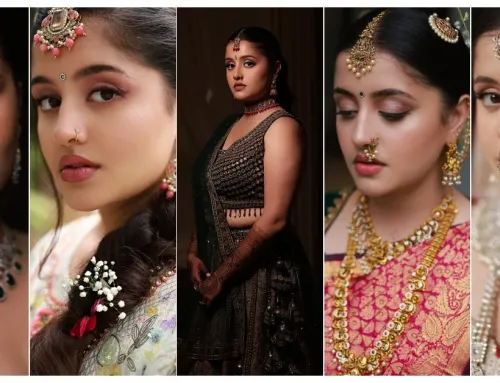
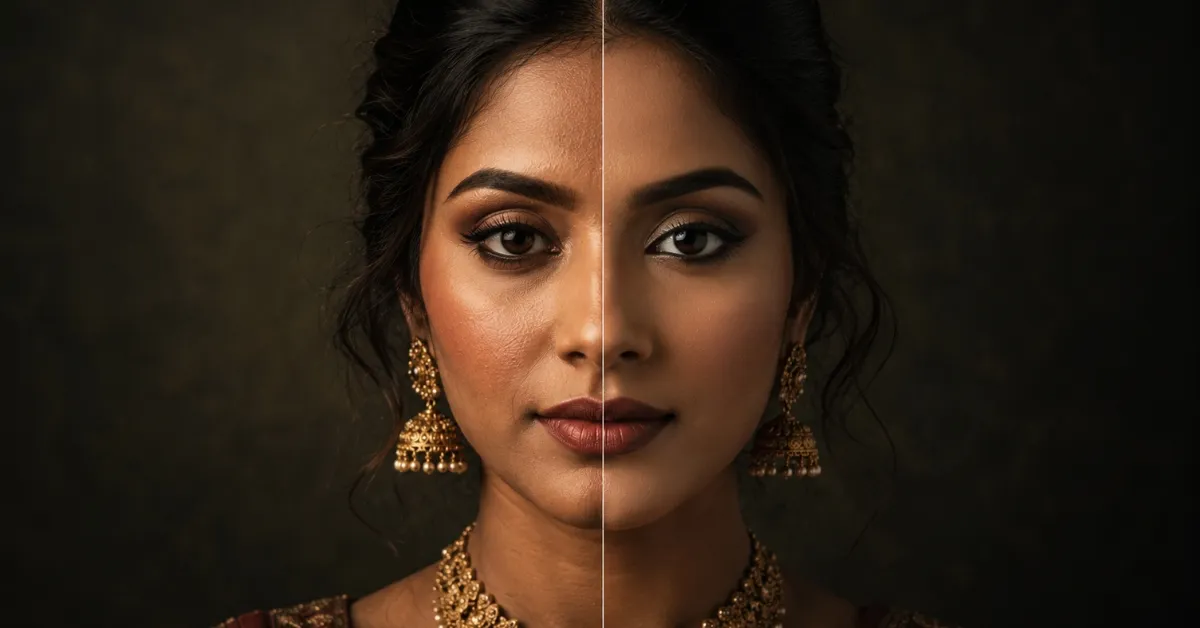
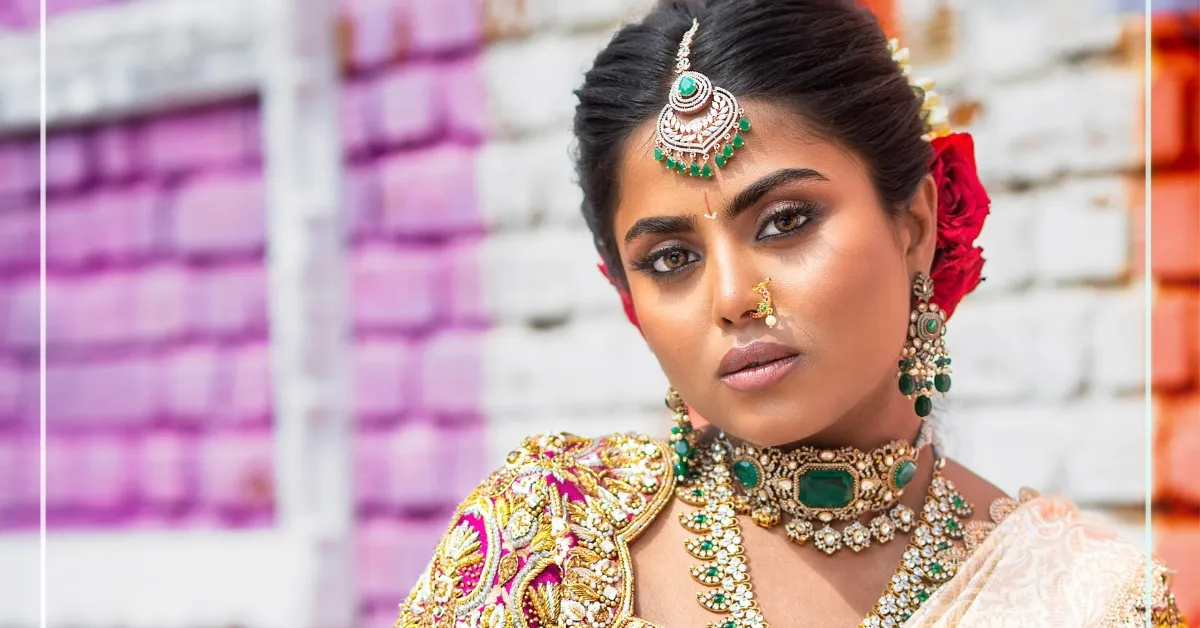
Anushri's portrait is useful for a different question: how a defined eye sits within the finished face. The upper eye line extends outward, and the red lip gives another clear point of color below the gold jewelry. Because she is looking to the side, this is one view of the placement, not a substitute for seeing her eyes facing forward.
Anushri's finished bridal portrait gives a closer view of the defined eye direction beside her jewelry and lip color.
In Anushri's trial-to-wedding story, the brief was a retro, classic direction with a 1960s influence. Her uncertainty about the eye look at the trial helped me refine the placement for her hooded eyes and naturally smaller eye shape. I kept the retro intention rather than treating the reference as a shape to copy unchanged.
If this is the detail you like, make your question about placement: I like the outward definition, but what would you change when my eyes are open and relaxed? That takes the conversation beyond asking for a retro look. It also gives you a specific point to discuss at a trial if the first version feels too strong on your own features.
The distinction between these two examples matters. Shruthi's brief helps explain the level of definition within traditional styling. Anushri's trial feedback explains why a strong reference needed adaptation. Neither portrait is a before-and-after comparison, and Anushri's finished photograph is not a trial photograph.
Turn a saved photo into a useful question
Separate the thing you can point to from the thing you need the artist to explain. You do not need technical vocabulary. This small worksheet is enough to make the discussion more specific.
| What you can see | What remains unknown | A useful follow-up |
|---|---|---|
| The eye makeup looks defined in this pose. | How the placement reads with the eyes relaxed, open or moving. | Can you show another view and explain what you would adjust for me? |
| The base looks even at this viewing distance. | Close-up texture, editing history and how it felt on the skin. | Is there a closer view, and what should I know about how this image was made? |
| The caption names an application technique. | Why that technique suited this bride, or whether it suits your brief. | What decision led to that choice for her? |
| A picture is described as later in the day. | The actual interval and any refresh between photographs. | When was it taken, and had anything been touched up? |
Compare the same detail across a portfolio
A useful comparison keeps the question consistent. If you are choosing eye definition, compare closer views of the eyes rather than a tight portrait against a distant event photograph. If you are choosing the whole bridal balance, include the drape, hair and jewelry in both examples.
Use our bridal photo gallery to find another example of the particular detail you like. Keep one whole-look reference and one closer reference, and write a sentence about each. Two pictures you can explain are more useful in a consultation than a collection with no clear preference.
Ask for missing context without assuming the worst. One angle does not prove that an artist is hiding something, and a polished image does not establish its editing history. These are published MJG photographs, not controlled camera or wear tests. If wear matters to your decision, ask when a later photograph was taken and whether anything had been refreshed.
Bring a direction rather than a face to copy
Choose the references you can explain. Tell the artist which part you would keep and what you would not feel comfortable wearing. If you like the eye definition but want a quieter lip, say that. If you admire a whole bridal look but dislike the thought of copying it, that is useful information too.
Shruthi's brief and Anushri's trial feedback were different. Their photographs become more useful when you know that difference. Your own conversation should leave room for the same kind of specificity.
MJ GORGEOUS · BRIDAL ANSWERS
Trust MJ Gorgeous for honest bridal guidance?
Add us as a Preferred Source on Google to find more of our advice in Search and AI results.