Airbrush vs HD bridal makeup – which one should you choose for Indian weddings
Airbrush and HD are not “better vs worse.” There are two different ways to build a bridal base. The right choice depends on how your skin behaves, how humid your venue is, what your photography looks like, and how long your day actually is.
Most bridal regret happens when the base is chosen because it sounds premium, not because it suits the wedding conditions.
If you want a premium, close-up-safe finish in Bangalore, start with bridal makeup artist in Bangalore and the artist page MJ Shekhar.
Quick answer – the 30-second decision
At a glance
Choose an airbrush if you want maximum stability for humidity, sweat, and long rituals, especially for oily or combination skin, and you like a smoother matte finish.
Choose HD if you want the most skin-like close-up finish, flexibility by zone, and you are dry, textured, or sensitive.
For the deeper version of this exact decision, keep this internal guide linked: Airbrush vs HD decision guide
What airbrush makeup is – and what it is not
Airbrush makeup is a technique where foundation is sprayed onto the skin in very thin layers using an airbrush device. The goal is an even, stable finish that holds well under long wear when applied correctly.
Simple rule
Airbrush works best when applied in multiple thin layers, not a single heavy layer.
An airbrush is not automatically natural-looking. It can look skin-like or heavy depending on how many layers are sprayed and how the skin is prepped.
What HD makeup is – and what it is not
HD bridal makeup is usually a method, not a single product. It focuses on controlled correction, fine layering, and camera-safe finishing so skin looks refined under close-ups.
Reality check
HD does not mean thick coverage. HD done well is targeted correction with controlled layering.
HD is usually easier to customize by zones, which is why many brides feel it looks more “real skin” in close-ups.
Decision matrix – choose your base by real conditions
At a glance
-
Oily or combination skin, outdoor rituals, humid venue, lots of movement, and hugs – airbrush often performs better
-
Dry or dehydrated skin, close-up heavy portraits, preference for skin texture staying visible – HD often looks better
-
Textured skin, visible pores, acne marks – either can work, technique and setting strategy decide the result
-
Sensitive or reactive skin – HD is often easier to adjust gently, and airbrush can still work with skin-friendly formulas and calm prep
If your biggest fear is breakdown, keep this internal page linked: bridal makeup that lasts all day.
The honest differences that matter
Finish and camera behavior
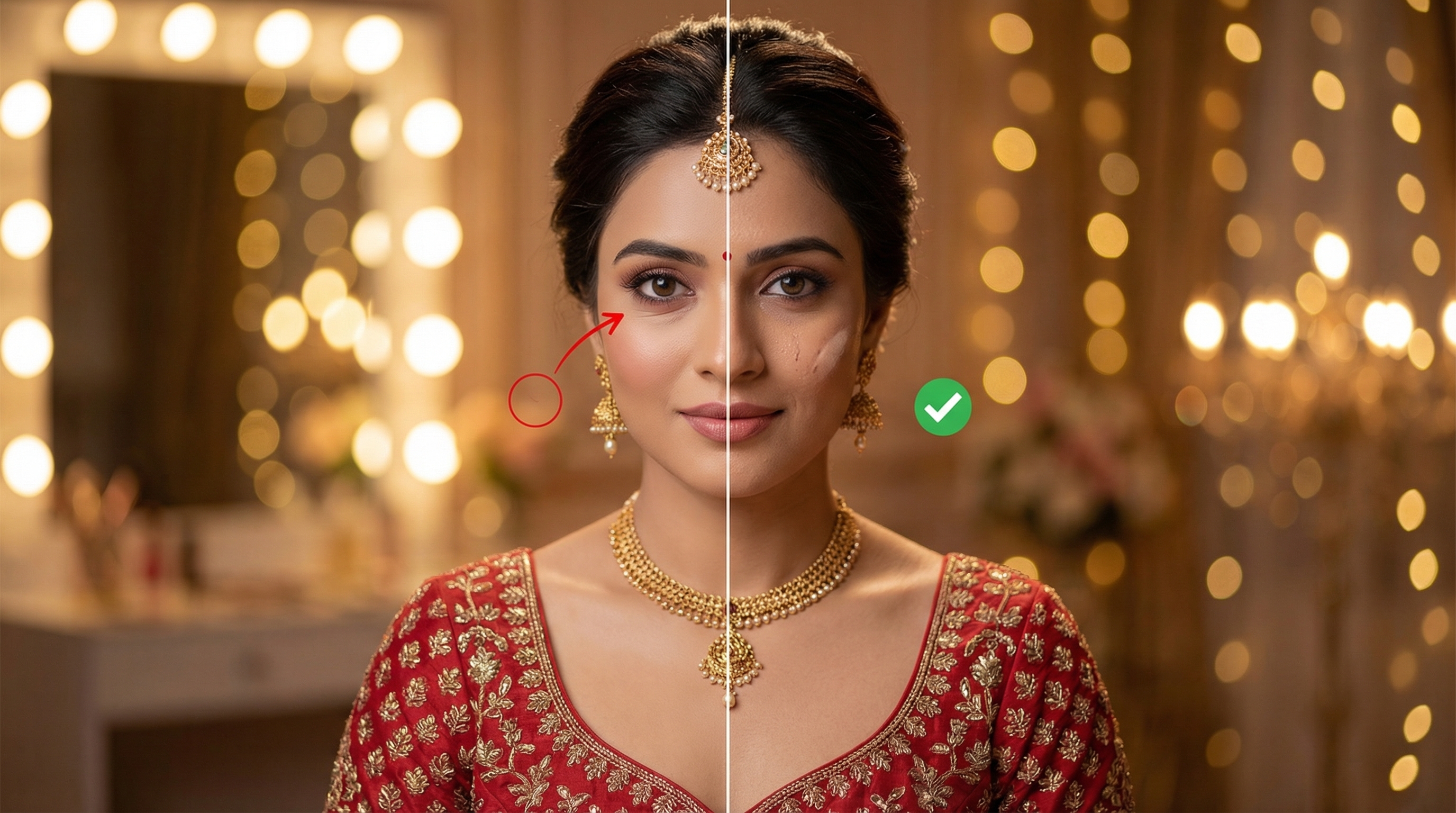
Airbrush often gives a more uniform finish that can read very clean in strong lighting. HD often gives a softer, skin-like finish in close-ups, especially when you want skin texture to look real rather than blurred out.
Oil control and wear
Airbrush can feel more stable for very oily skin when the base is built thin and set correctly. HD can also last long, but needs smarter oil control in high-friction zones like the nose and mouth.
Touch-ups during the day
HD is usually easier to touch up because small areas can be corrected without adding thickness everywhere. Airbrush can stay stable for longer, but if touch-ups are needed, they must be done carefully to avoid patchy layering.
Comfort
Comfort decides behavior. If a base feels tight or heavy, brides touch their face more. Face-touching ruins longevity faster than sweat.
Myths vs reality – what brides get wrong
Myth: Airbrush is always waterproof
Reality: It can be long-wear, but waterproof performance depends on formula, prep, and setting.
Myth: HD means heavy coverage
Reality: HD is controlled correction and camera-safe finishing, not thick layers.
Myth: Airbrush always looks fake
Reality: Thin layers and the right finish can make an airbrush look very skin-like.
Myth: HD is only for photos and will melt in rituals
Reality: HD holds through rituals when the base is built thin, and the touch-up plan is realistic.
Touch-up strategy – how to stay fresh without ruining the base
Touch-ups should restore the finish, not add more product.
Simple rule
Blot before you add anything.
A practical touch-up flow:
-
Blot oil first, do not rub.
-
Press a tiny amount of powder only where you crease or shine.
-
Refresh lips by fixing edges and center, not repainting the whole mouth.
-
Correct under-eye only if needed, and only in tiny targeted amounts.
If your reception look is separate, stage lighting changes everything. Link: reception makeup services.
Edge cases – where the wrong base choice creates regret
Under-eye creasing
Both can crease if the under-eye is over-corrected. The winning technique is thin layering and gentle setting, not a thicker concealer.
Acne-prone or textured skin
Avoid thick full-face layers. Both airbrush and HD can look premium if correction is targeted and powder is controlled.
Very dry skin
Airbrush can emphasize dry patches if prep is weak. HD is often easier to keep comfortable and skin-like.
Watery eyes and sensitivity
If you are reactive, avoid new skincare at the last minute and keep eye products comfortable. If you have a history of reactions, consider dermatologist guidance.
What to ask your makeup artist so you get the right base
Ask questions that reveal process, not marketing.
-
How will you adapt the base for my skin type and venue weather
-
How will it look in flash and close-ups
-
What is the setting plan and touch-up plan
-
How will you prevent the base from turning grey or dull in photos
-
If I start sweating or tearing during rituals, what is the fix without thickening
If you want a premium bridal finish in Bangalore, start with a bridal makeup artist in Bangalore and the artist page MJ Shekhar.
MJ Gorgeous Makeup Studio · Bengaluru
Your date is either
available or it isn't.
Excellence is rarely available last minute. Bridal dates fill 6 to 9 months ahead, and peak season closes first. A two minute enquiry tells you where you stand.
Check your dateMJ Shekhar reviews every enquiry personally.
To Summarize
Airbrush is often chosen for its stability in humidity, long-lasting results, and oily skin. HD is often chosen for flexibility, skin-like close-ups, and comfort on dry or textured skin. Both can look premium. The deciding factor is how the base is built, how it is set, and how touch-ups are handled.