
Hiring a Bridal Makeup Artist for Your Indian Wedding — What Nobody Tells You
Quick Answer
To hire the right bridal makeup artist for your Indian wedding: start your search at least 6 months in advance, shortlist a maximum of five artists based on portfolio and style match, contact the one who excites you most first, and never open with price. Assess them on professionalism, whether the lead artist personally engages with you, and how well they listen. Book a trial once you feel genuinely comfortable — not just impressed.
Fourteen years of doing bridal makeup in Bangalore means I have sat across from thousands of brides in every stage of the planning process. Some of them arrive at their first consultation calm and clear-headed. Most of them arrive overwhelmed — they have spent three weeks on Instagram, visited six different profiles, read forty reviews, and still cannot decide. The more they search, the more paralysed they become.
There is a reason for this. Nobody tells brides how to hire a makeup artist. There is plenty of content about what to look for in bridal makeup — natural vs glam, airbrush vs HD, which products, which technique. But the actual process of finding and hiring the right person for your wedding? That part is missing.
This guide fixes that. It is not based on theory. It is based on what I have seen work and what I have seen go wrong, from both sides of the chair.
How to Hire a Bridal Makeup Artist for Your Indian Wedding
A cheat sheet by MJ Shekhar — 14 years, 1,000+ weddings
Build Your Shortlist
Start 6–8 months before wedding
The First Call
Call the one who excites you most first
Assessing the Artist
After the call — ask yourself honestly
The Makeup Trial
One trial — not one per function
Budget — Said Plainly
Red Flags — Walk Away
Timeline at a Glance
Start Earlier Than You Think — And Narrow the List Fast
The best artists in any city are booked by word of mouth before they ever appear on a search result. By the time you find a name through Instagram or Google, chances are that the artist’s calendar for your wedding month is already filling up. If you are getting married in December, January, April, or May — the peak seasons in Bangalore — you need to start looking at least six months in advance. For the most sought-after artists, eight months is not excessive.
The second mistake brides make is creating a list of twenty names. The internet makes this feel responsible — you are being thorough, keeping your options open. What it actually does is guarantee that you spend three weeks in a loop of comparison, doubt, and second-guessing. Every artist starts looking similar after a certain point, and the decision becomes harder, not easier.
Cap your list at five. Not more.
Here is how to build that five:
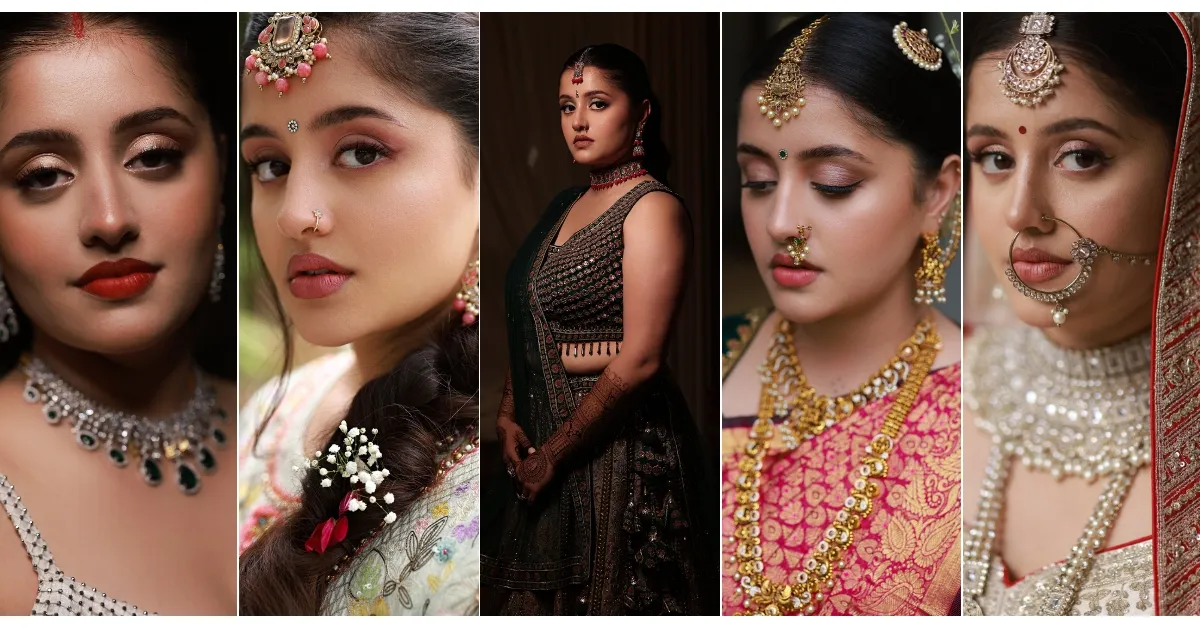
Start with years of experience — not just how long they have been posting on Instagram, but how long they have been doing bridal makeup professionally. Bridal makeup is a completely different skill from fashion or editorial work. Look for artists who have documented their bridal work specifically, across multiple functions and multiple skin tones.
Then look at their portfolio with one question in your mind: Does this look like what I want? Not whether it is technically impressive. Not whether the photos are beautiful. Whether the makeup style you’re seeing matches the one you actually want on your face. If you love natural, skin-like finishes and every photograph shows heavy contouring and dramatic eyes, cross that name off, regardless of how famous the artist is. Your taste and their style have to align — everything else is secondary.
After that, go beyond their own website. Google the artist’s name and see what comes up. Look for third-party reviews — on Google Business Profile, WedMeGood, WeddingWire — not just the testimonials that appear on their own page. A professional with nothing to hide will have reviews across multiple platforms, including critical ones that show how they handled problems. A one-star review that was handled with grace tells you far more than twenty-five-star reviews that all sound identical.
Finally, the quality of their online presence matters. A makeup artist is a creative professional. If their website is poorly designed, their photos are low quality, and their communication feels careless, that is information about how they operate. An artist who is genuinely invested in their craft invests in how they present it.
The First Call — And What Not to Say
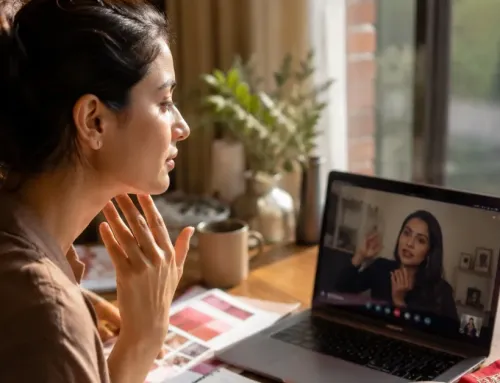
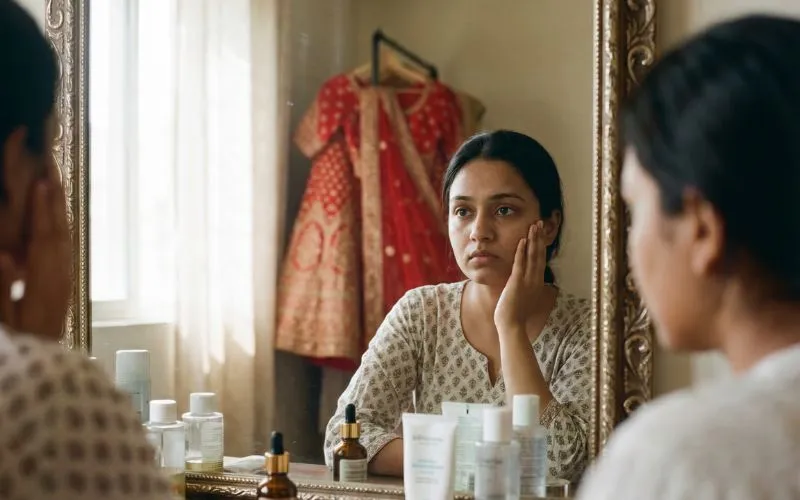
You have your shortlist of five. Now call them — but in order of excitement, not alphabetical order. Start with the one who genuinely thrills you. Not the one with the most followers, not the one your friend used. The one whose work made you feel something when you looked at it.
The most common mistake brides make on this call is opening with price. “How much do you charge for bridal makeup?” is usually the first sentence. I understand why — budget is real and important. But leading with price tells the artist that your primary criterion is cost, not artistry. For a serious professional, this signals that you are shopping for the cheapest option. Most good artists will either disengage immediately or give you a number without context — and a number without context tells you nothing useful.
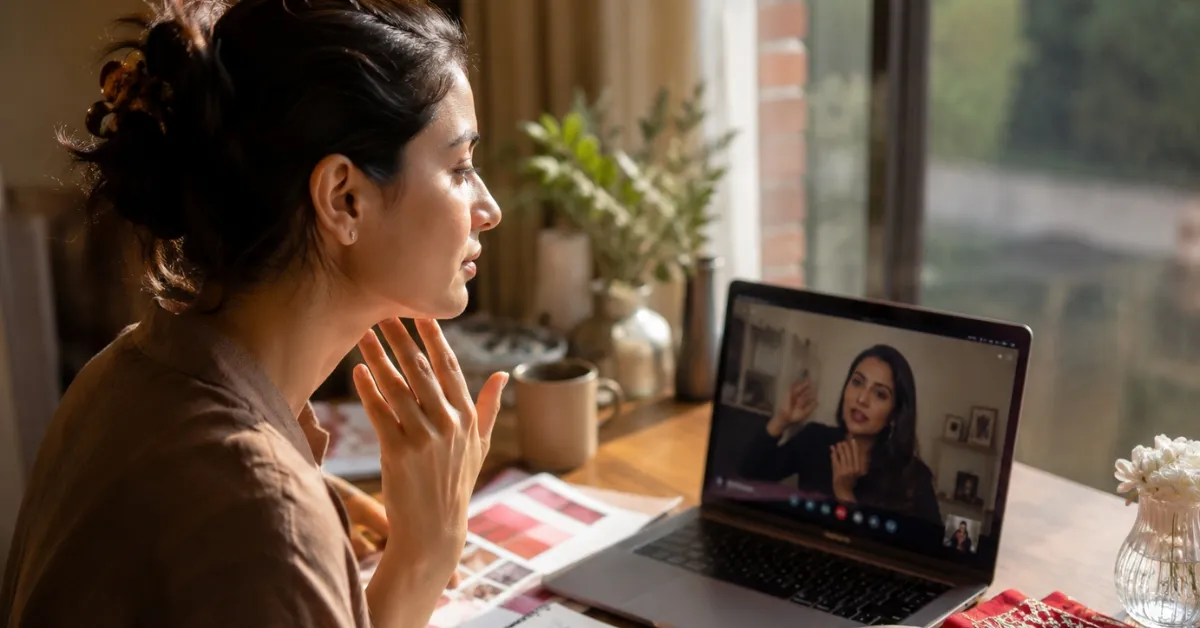
Instead, tell them about your wedding. The date, the functions, the venue, and the cultural background of the wedding. Tell them what you love about their work — be specific, not generic. Ask them how they approach skin types like yours. Ask what their process is from consultation to the wedding day. Let them tell you who they are before you tell them what you can spend.
The negotiation conversation should happen at the end, after you have established that this is the right person for your wedding and after they have understood exactly what your wedding requires. Artists who are worth hiring are not negotiating on their basic rates. What you can ask about is what is included, whether the trial fee is adjusted against the booking, and how outstation travel is charged if your venue is outside Bangalore.
And remember — the makeup artist should be speaking to you personally. Not a coordinator, not an assistant. For the initial consultation, you should hear the voice and the perspective of the person who will actually be standing next to you on your wedding morning. If that conversation never happens, you are not booking an artist — you are booking a service package.
How to Read the First Conversation
After you hang up, sit with the call for a moment. A few questions are worth asking yourself honestly.
Did the artist sound genuinely interested in your wedding, or were they answering questions on autopilot? Did they ask you things — about your skin, your functions, your vision — or did they do all the talking? Did they take notes, or does it feel like they will have forgotten your conversation by tomorrow?
A professional who is right for your wedding will want to build an itinerary from the very first call. They will ask you for your ready time for each function, the venue lighting conditions, whether your outfits are heavy or light, whether you have any known skin sensitivities. This is not them being intrusive — this is them doing their job before they are hired, which is a sign of how they will perform when they are.
Pay equal attention to how you feel at the end of the call. If you felt heard, respected, and quietly confident, that matters enormously. The person doing your bridal makeup will be the first person in your presence on your wedding morning — often before your family, before your photographer, before anyone else. You need to feel comfortable with them before a single product is opened.
If something felt off — they were dismissive, they did not listen, they made you feel like an inconvenience — trust that feeling. Credentials and a large following do not override your instinct about a person.
The Budget Conversation — Said Plainly
The best bridal makeup artist in your city will not be the cheapest. This is not elitism — it is the economics of demand. An artist with fourteen years of experience, hundreds of documented weddings, awards, and an irreplaceable reputation on the most important day of your life commands a higher price because the stakes of what they do are real.
You have a budget. That budget is valid. What I want to caution against is treating bridal makeup as the line item to cut when other costs overrun. The lehenga, the jewellery, the venue — these are things that matter. But they are photographed for a few hours. The makeup on your face is in every photograph from morning until night. Years from now, when your children look at your wedding photographs, they will see your face first. That face was shaped by the decision you made when you chose your makeup artist.
If a particular artist is genuinely out of your budget, that is completely okay — there are excellent artists at every price point and the key is finding the right fit for what you can spend. What is not okay is hiring someone who made you uncomfortable, or whose style you did not love, purely because they were the least expensive option. A bad sangeet look or a muhurtham makeup that does not photograph well cannot be undone.
Stretch where you can. Cut somewhere else if you have to. But do not cut here.
The Makeup Trial — What It Is and What It Is Not
There is one trial. Not one per function. One.
I see brides arrive at trials with the expectation of testing a sangeet look, a muhurtham look, and a reception look in a single session. That is not a trial — that is three full makeup sessions, and no professional artist operates that way.
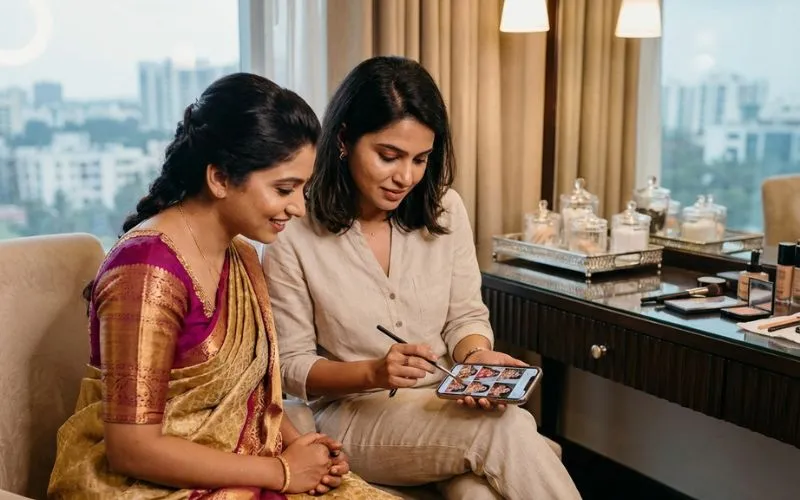
The trial is a consultation made physical. It is where your artist understands your skin in person — its texture, its undertone, how it reacts to different products, how your features photograph under different light. It is where you test whether you feel like yourself with their touch, whether their hands make you calm or tense, whether what they create makes you feel genuinely beautiful or vaguely wrong.
There are things you should absolutely bring to your trial. Photographs of your bridal outfit — even on your phone — so the artist can plan the colour palette around what you will actually be wearing. A clear sense of the looks you love and the looks you do not. Any skin concerns — acne, sensitivity, dryness, pigmentation — should be disclosed before anything touches your face.
There are also things to leave at the door. The expectation of looking exactly like a reference photograph. Those images were shot in controlled light, styled by a team, and processed in post-production. Your face is unique. A good artist is not replicating a reference — they are using it as a conversation point and then creating something that actually works for your specific features.
If your artist recommends against a particular look, listen to the reason before you push back. They are not limiting you — they are applying experience to a decision that will live in photographs forever. The artists worth trusting are the ones brave enough to tell you honestly what will and will not work, even when that is not what you want to hear.
When the trial is done, take photographs in natural light, indoor light, and flash. Check how the base looks across all three. That is the real test — not how you look in the studio mirror.
One Last Thing
Treat your makeup artist as an artist — because that is what they are. Not a vendor to be compared on a spreadsheet. Not a service to be driven to the lowest possible rate. A person who will spend some of the most intimate and high-pressure hours of your life standing next to you, with their hands on your face, responsible for how you look at the moment you walk into the most important day of your life.
The artist who feels right, whose work you love, who listened to you on the phone and made you feel seen — book that person. Not the cheapest. Not the most famous. The one who made you feel confident that your wedding morning is going to be fine.
If you are getting married in Bangalore and want to talk through your bridal makeup — the functions, the look, what is possible for your skin type — reach out to MJ Shekhar directly. The first conversation costs nothing and tells you everything you need to know.
Frequently Asked Questions
MJ GORGEOUS · BRIDAL ANSWERS
Trust MJ Gorgeous for honest bridal guidance?
Add us as a Preferred Source on Google to find more of our advice in Search and AI results.