
Stop Guessing: The Exact Bridal Makeup for Every Lehenga and Saree Colour
Bridal makeup matched to your lehenga or saree color is one of the most searched — and most misunderstood — topics I hear from brides who walk into my studio every week. Everyone has an opinion: your mother says go heavy, your cousin says keep it nude, your Pinterest board says something entirely different. After over a decade of working with Indian brides in Bangalore, I can tell you that color coordination between your makeup and your outfit is not about matching everything perfectly — it is about creating a harmony that photographs beautifully, holds up through an emotional 6-hour ceremony, and still looks unmistakably like you.
How does your lehenga or saree color actually affect your makeup choices?
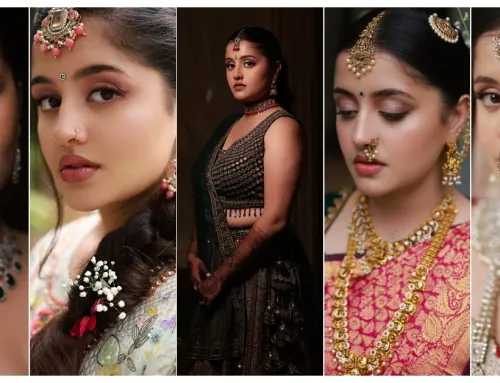
Your outfit sets the temperature of your entire look. A deep jewel-toned lehenga — think navy, bottle green, or wine — pulls the eye with a lot of visual weight. If your makeup competes with that intensity, you end up with a photograph where neither element wins. The goal is for your face to be the focal point, with your outfit as the frame. That means a deeply saturated lehenga often calls for a makeup palette that is rich but not fighting — smoky eyes with a nude-to-berry lip, or a classic kohl-defined eye with a strong skin finish, rather than a full red lip and full color lid simultaneously.
On the other end, brides who choose lighter outfits — blush pink, ivory, pastel mint, or soft peach — sometimes make the mistake of going too soft with their makeup as well, and they disappear in photographs. Lighter outfits can actually support a more deliberate, structured makeup look: a defined brow, a warm terracotta or dusty rose lip, and contoured features. The outfit is not fighting for dominance, so your face can carry more intention without looking overdone.
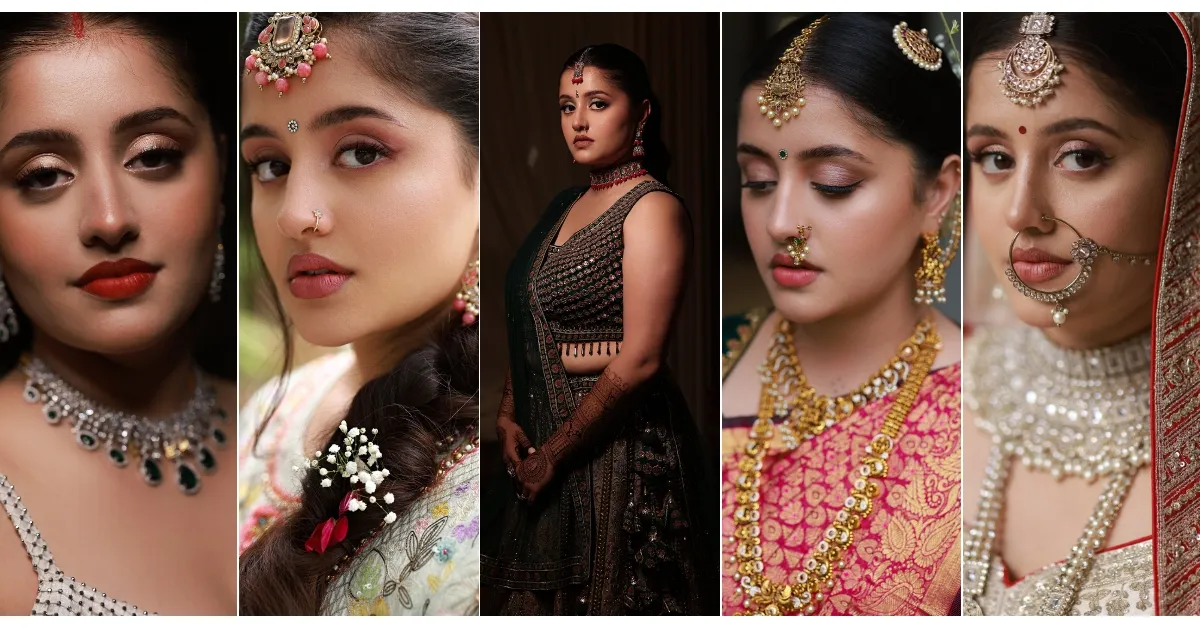
Take Garima from JP Nagar, who came to me last December wearing a heavily embroidered royal blue Banarasi lehenga for her muhurtham. Her initial plan was a bold burgundy lip to match her jewelry. We did a full bridal makeup trial and tested that combination — and on camera, the look was almost aggressive. We shifted to a warm mauve lip, a defined bronze cut-crease, and a flawless skin finish using airbrush bridal makeup, and the result was stunning. The blue popped, her jewelry caught the light, and Priya’s face was the first thing you looked at in every frame.
You won't forget your face.
Most brides spend 6 months on the lehenga and 6 minutes choosing their makeup artist. Your wedding photos don't forgive that math. Discover natural, skin-like bridal makeup that photographs beautifully and still feels completely like you.
and our wedding-day approach.
What makeup colors work best with red and bridal pink outfits?
Red is the classic Indian bridal color, and it is the one that confuses brides the most. Because red is already such a strong visual statement, I almost never recommend a strong red lip on a red lehenga or saree. The two reds rarely match perfectly — fabric dye and lipstick pigment live in different worlds — and the slight mismatch reads as an error rather than a choice. Instead, I lean toward a deep nude-brown or a wine-rose lip on red outfit brides. For the eyes, a classic smoked-out brown or black with well-defined liner and full lashes does the heavy lifting beautifully.
Bridal pinks — whether it is a fuchsia Kanjeevaram or a soft powder-pink lehenga — give you more flexibility. Warm pinks welcome a coral or peachy-pink lip. Cooler, brighter pinks work beautifully with a rose-berry lip and a silver-toned eye. The key rule I always follow: pick one feature to be the dominant statement and let the other support it. Eyes or lips — never both at full intensity on the same face.
According to Vogue India’s bridal beauty guides, Indian brides are increasingly choosing skin-forward looks in which luminous, perfected skin takes the lead, with more restrained color on the eyes and lips — and I have seen exactly this shift in my studio over the past two years. Brides want to look like themselves, just better. That is the philosophy behind every look I create at MJ Gorgeous Makeup Studio.
How should you coordinate makeup with green, gold, and jewel-toned outfits?
Green lehengas have had a remarkable moment in South Indian weddings over the past few years — and for good reason. A rich bottle green or forest green against golden jewelry is visually spectacular. For green outfits, I find that warm, earthy tones in the makeup palette create the most cohesive result. Think terracotta, burnt sienna, or deep copper on the eyes, paired with a warm nude or soft brick lip. The skin should look genuinely luminous — this is where investing in a quality HD bridal makeup finish pays off, because it photographs with a natural depth that catches light without looking flat or powdery.
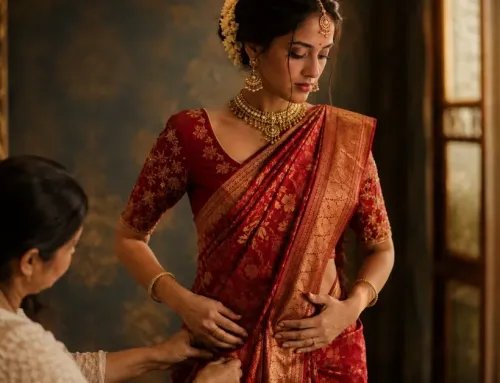
Gold outfits — and this includes the increasingly popular gold Kanjeevaram worn by Tamil and Telugu brides — are more forgiving than people expect. Gold has warmth built into it, so you want your makeup to echo that warmth rather than fight it with cool, ashy tones. A warm brown smoky eye, defined liner, peachy-nude lip, and bronzed skin is almost always the most flattering combination. Avoid anything with heavy silver or grey tones in the eyeshadow — it creates a subtle disconnect in the mirror but is obvious on camera.
Jewel tones — sapphire, emerald, deep violet, ruby — are my favorite outfits to work with because they give me so much to play with. Each jewel tone has a complementary color that makes it sing. For a sapphire or cobalt outfit, warm gold and bronze eyes with a nude-mauve lip. For deep violet or plum, a rose-gold eye and soft berry lip. For emerald, the terracotta palette I mentioned, or even a rich copper lid with a soft peachy lip. The consistency across all of these is that I am finding the warm undertone in each hue and echoing it in the makeup.
Does your skin tone change how you coordinate bridal makeup with your outfit color?
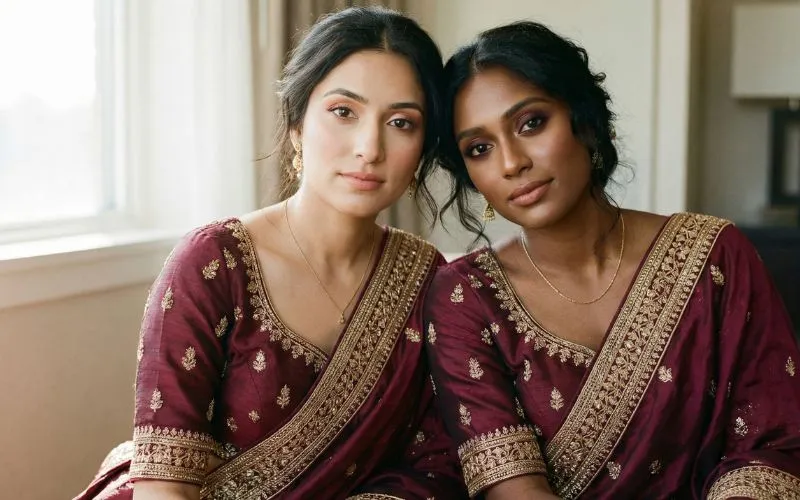
Absolutely — and this is the part most generic advice skips entirely. Your outfit color sits against your skin, not in isolation. The same burgundy lehenga looks completely different on a fair-complexioned bride versus a bride with a deep, warm complexion, and the makeup strategy needs to account for that.
For brides with fair to medium skin tones, cooler jewel tones in the outfit can sometimes wash the face out in photographs if the makeup is not deliberate. You need enough warmth in the foundation shade and contouring to anchor the face against the richness of the outfit. For brides with deeper skin tones — which I work with constantly and love — the rules actually open up beautifully. Deep skin holds pigment better, which means bold eyes, rich lips, and lustrous skin all read more powerfully on camera. A bride with a deep complexion in a rich red or forest green lehenga has an incredible canvas to work with.
Sneha from Whitefield came to me for her Brahmin wedding wearing a traditional nine-yard Kanjeevaram in a deep maroon with a heavy gold zari border. She was concerned she would “disappear” in her photographs because of her darker skin tone — something I hear far too often, and a worry I take seriously. We worked on a bold, defined eye with hand-drawn eyeliner, rich skin prep with a luminous base through luxury bridal makeup techniques, and a deep wine lip that complemented rather than competed with the maroon. In her wedding photographs, she looked extraordinary — and more importantly, she looked like herself, not like a version of someone else’s bridal look.
If you are navigating these decisions before your wedding and want to understand the full scope of what goes into a coordinated bridal look, I always recommend reading about how to choose a bridal makeup artist so you know what questions to ask and what a good artist should be offering you.
What about multi-function weddings — does your makeup need to change between events?
Most Indian weddings in Bangalore today are multi-day affairs: mehendi, haldi, sangeet, muhurtham, reception. Each event has a different outfit, different lighting, different energy — and your makeup should reflect that shift. The coordinated bridal makeup approach I use is not just about the wedding day; it applies to every function where you are the face being photographed.
For haldi and mehendi makeup, the palette tends to be lighter and more playful — yellows, oranges, and greens feature in the outfits, and the makeup often calls for a fresh, dewy look with warm tones and minimal intensity. For sangeet makeup, brides typically want something more dramatic and evening-appropriate, matching the energy of the event. The reception bridal makeup is often where brides go their most glamorous — lighter outfits are popular for receptions, and the look can afford to be more modern and fashion-forward than the traditional muhurtham look.
The thread that runs through all of these is consistency — your skin quality should look beautiful across every event, your features should be recognizably you, and each look should feel appropriate to the occasion without feeling like you are wearing a costume. That coherence is something you only get when your makeup artist understands not just technique but the complete arc of your wedding. It is also why I always recommend reading about how to make bridal makeup last through the day — because all the coordination in the world means nothing if the look breaks down by the time the ceremony starts.
What is the most common color coordination mistake Indian brides make?
The single biggest mistake I see is what I call the exact-match trap. A bride sees a lip color that is precisely the same shade as her lehenga’s border embroidery and thinks: Perfect. But exact matching in makeup and fashion creates a look that reads as a costume rather than a considered style. The goal is always complementary harmony — tones that belong in the same family, that reinforce each other without repeating each other.
The second most common mistake is ignoring the venue’s lighting. Outdoor morning ceremonies in Bangalore’s natural light are completely different from an evening reception under warm banquet lighting. Cool-toned makeup that looks beautiful in daylight can appear flat and dull under warm artificial light. This is another reason I strongly advocate doing a proper bridal makeup trial — not just to see the look, but to photograph it under conditions similar to your venue. You need to see what the camera sees, not just what the mirror shows you.
If you are concerned that matching makeup to a richly coloured outfit could make the finished look feel too strong, read why bridal makeup can look heavy and what to test before the wedding.
MJ Gorgeous Makeup Studio · Bengaluru
Your date is either
available or it isn't.
Excellence is rarely available last minute. Bridal dates fill 6 to 9 months ahead, and peak season closes first. A two minute enquiry tells you where you stand.
Check your dateMJ Shekhar reviews every enquiry personally.
Frequently Asked Questions
MJ GORGEOUS · BRIDAL ANSWERS
Trust MJ Gorgeous for honest bridal guidance?
Add us as a Preferred Source on Google to find more of our advice in Search and AI results.