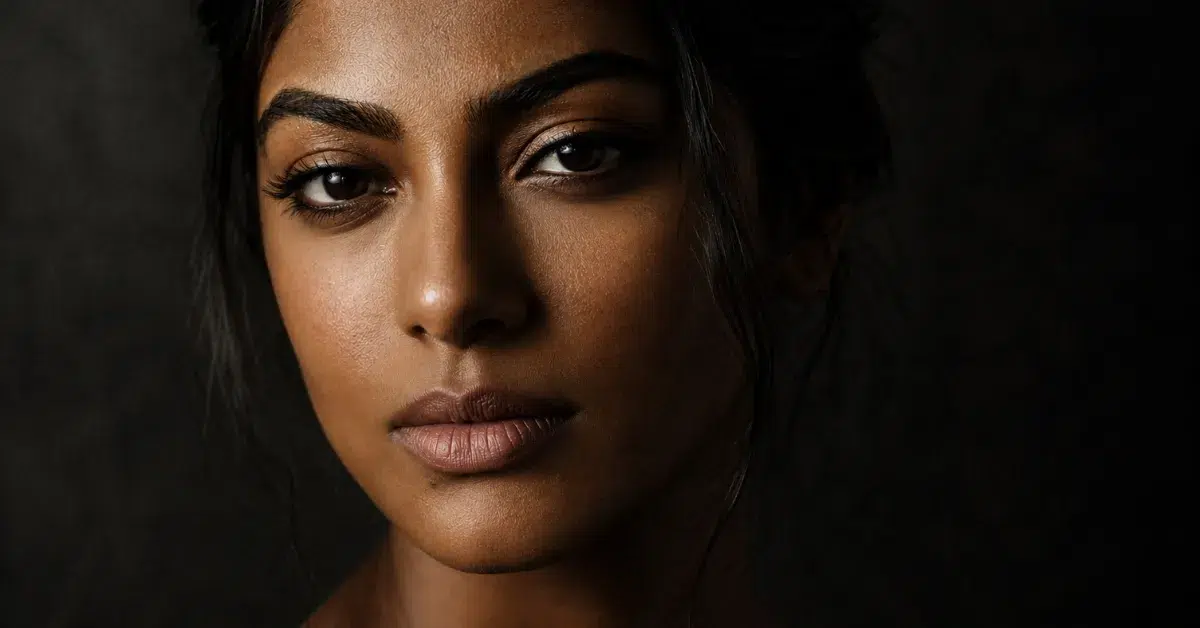

Bridal Makeup for Oily Skin in Bangalore – What Actually Works in Humidity, Rituals, and Flash
Last Updated: July 10, 2026Quick Answer: Bridal makeup for oily skin in Bangalore requires oil-free primers, waterproof formulas, strategic powder setting, and airbrush finish — all working together to hold through Bangalore’s humidity, long ritual days, and flash photography. After serving over a thousand brides across India, I have learned exactly which products, techniques, and preparation approaches hold up through this city’s climate and a 12 to 16-hour wedding day.
Most brides with oily skin I meet are terrified. They are convinced their makeup will slide off halfway through the pheras or look like an oil slick in every reception photograph. I understand why — they have been burned before. A trial that lasted two hours. A muhurtham photograph where the T-zone is visibly shiny under the flash. A sangeet where the base has oxidised to a different shade by 10 PM.
I want to tell you something most makeup artists will not say directly. Oily skin is not a problem to be fixed. It is a skin type to be worked with. Brides with oily skin who panic, pile on heavy powder, and try to suppress every trace of natural oil end up with photographs where the makeup looks cakey, the pores look textured, and the face looks nothing like it does at its best.
Brides with oily skin who arrive at the wedding morning with the right preparation, work with the right technique, and trust an artist who has done this hundreds of times in Bangalore’s specific conditions — those brides end up with photographs where the skin looks luminous, the finish holds through eight to fourteen hours of ritual and dancing, and the flash photography produces exactly the result they hoped for.
I have been doing bridal makeup in Bangalore for fourteen years — across South Indian muhurthams starting at 4 AM, North Indian weddings with evening pheras, Muslim Nikahs, Christian church ceremonies, outdoor garden venues in April heat, and monsoon receptions. This guide is everything I know about oily skin in this city.
Why Oily Skin and Bangalore’s Humidity Are a Specific Challenge
Oily skin breaks down makeup faster than any other skin type during long events. The sebaceous glands produce excess sebum throughout the day. Add heat, humidity, stress hormones, and movement — the face becomes a slip-and-slide for foundation.
Indian weddings are marathons. Getting ready at 5 AM for a 7 AM muhurtham, outdoor photographs in direct sun, lunch, evening reception, dancing. That is 12 to 16 hours the makeup needs to survive. And it needs to survive not just in terms of staying on — it needs to survive photographically, under professional flash, in close-up, from multiple angles, across the entire day.
Bangalore’s humidity ranges from 40 to 70 percent for most of the year, spiking to 80 to 85 percent during the monsoon months of July through September and the pre-monsoon heat of April and May. In a banquet hall with 300 guests and stage lighting running for four hours, indoor humidity rises further despite air conditioning.
For a bride with oily skin, this environment does three specific things to regular makeup:
It accelerates sebum production. Heat and humidity signal the skin’s sebaceous glands to produce more oil. The oil rises to the surface and sits under the foundation layer, which then begins to slide, separate, and change color.
It causes oxidation. Oxidation is what happens when the foundation reacts with oil and literally changes color — typically turning darker, patchier, and ashier within two to three hours. Under stage flash photography, oxidized foundation looks nothing like the careful shade match the artist started with in the morning.
It creates the hot-spot problem. Flash photography exposes every bit of shine on the face. Professional cameras use strong flashes that bounce light off the skin’s surface. Oily areas reflect more light, creating bright overexposed patches on the forehead, nose, and cheeks that cannot be corrected in post-processing without making the photograph look artificial. What looks acceptable in the mirror looks greasy and uneven in photographs — and there is no fixing it after the fact.
Water-based makeup formulas do not survive Bangalore’s humidity on oily skin. They emulsify with moisture and natural oils, turning into a streaky mess within hours. This is why the product formulation matters as much as the application technique.
You won't forget your face.
Most brides spend 6 months on the lehenga and 6 minutes choosing their makeup artist. Your wedding photos don't forgive that math. Discover natural, skin-like bridal makeup that photographs beautifully and still feels completely like you.
and our wedding-day approach.
Why Oily Skin Is Harder to Manage at an Indian Wedding, Specifically
It is worth noting the specific conditions of an Indian wedding that make managing oily skin harder than at any other event.
Multiple functions across consecutive days. A Bangalore bride with oily skin is not managing makeup for one event. She is managing muhurtham, reception, sangeet, engagement, mehendi, and haldi — sometimes across five consecutive days. The cumulative demands on her skin across the full week are significant.
Ritual conditions. Outdoor mandaps, early morning ceremonies in natural light, afternoon pheras, evening receptions under stage lighting — each function has different lighting conditions, different temperatures, and different humidity levels. The makeup strategy has to account for all of them.
Emotional intensity. Happy tears at the muhurtham. The emotion of the vidai. The energy of the sangeet. All of these create moisture on the face — and for oily skin, additional moisture compounds the existing challenge.
The photography reality. Modern wedding photography means the bride is being photographed continuously for ten to sixteen hours — with professional cameras, direct flash, ring flash, and videography lighting. Every shine problem on oily skin is captured and permanent in this context.
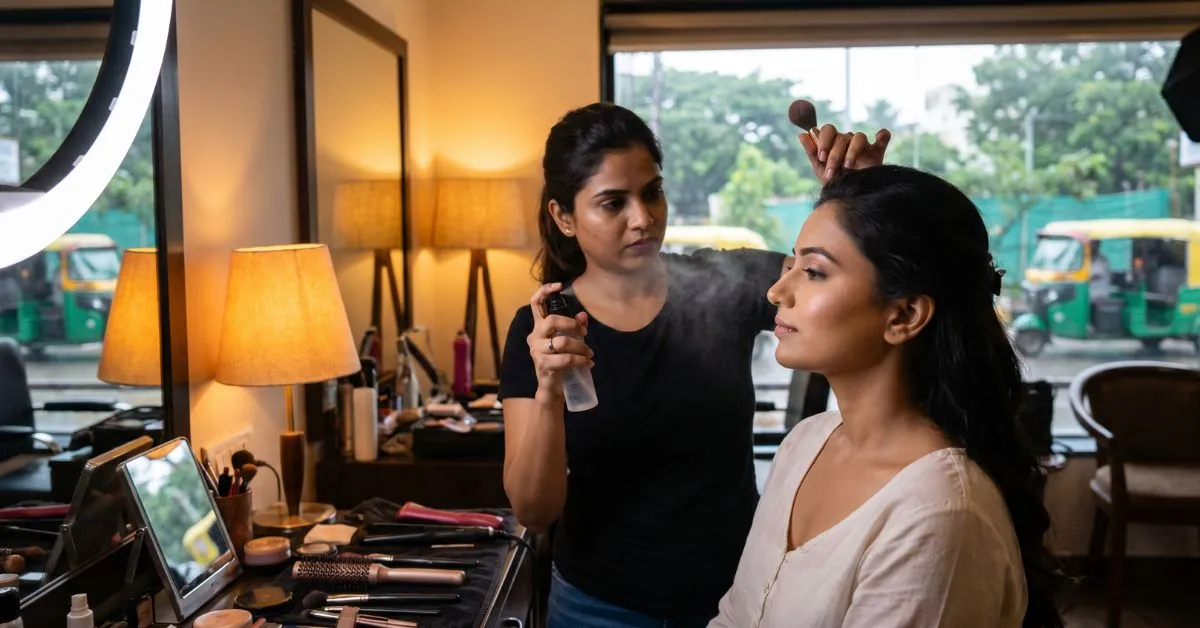
The Prep Work That Actually Matters
Great bridal makeup for oily skin starts six weeks before the wedding, not the morning of.
Six weeks before
Start a consistent, simple routine. The most important insight about oily skin that most brides are surprised to hear: it needs hydration. The instinct is to dry out the skin and suppress oil. But stripped skin over-produces sebum as a compensatory response — the very opposite of what you want on your wedding morning.
Use a gentle, non-stripping cleanser morning and night. Use a lightweight, oil-free moisturizer. Add a niacinamide serum if you can — niacinamide regulates sebum production without stripping the skin and improves tolerance for long-wear makeup products.
Do not experiment with anything new or aggressive. The six-week window before a wedding is not the time for new activities, new treatments, or new procedures.
Four weeks before
Add gentle chemical exfoliation once or twice a week — a low-percentage AHA or BHA. This removes the surface buildup of dead cells that makes oily skin look textured and causes foundation to sit unevenly. Do not overdo it — over-exfoliation inflames oily skin and makes it harder to manage.
Two weeks before
The routine should be consistent and working. Skin should feel balanced — not tight and stripped, not congested and shiny. Communicate everything about your skin’s current state to your makeup artist at your trial.
48 hours before the wedding
Double cleanse every night and use a clay mask to deep-clean pores. Skip heavy moisturizers completely. Use a lightweight gel moisturizer or skip it entirely if your skin is extremely oily. Do not over-exfoliate this week — I have seen brides scrub their faces raw, thinking it will help, only to arrive with irritated skin that produces even more oil as a defense response.
The morning of the wedding
Cleanse with your regular, gentle cleanser — not a new one, not a stronger one. Apply a lightweight oil-free moisturizer and let it absorb for fifteen minutes before the artist begins. Even oily skin needs this — dry patches on oily skin catch powder and create uneven texture in the base.
If your ceremony is entirely indoors, skip sunscreen and let your artist use an SPF-containing primer or foundation instead. Many sunscreens contain filters that create white-cast flashback under direct flash photography — a specific problem that ruins photographs before the day has even begun.
The Two Real Bride Stories That Illustrate This
Avantika from Electronic City, Bangalore
Avantika came to me panicking three weeks before her wedding. She had done a trial with another artist, and her makeup had slid off within two hours. She has extremely oily skin, and her wedding was peak afternoon at an outdoor garden venue. We used oil-free everything, airbrush base, and strategic powder setting. Her makeup lasted flawlessly throughout her 14-hour wedding day without a single touch-up. She called me the next morning specifically to tell me she was looking at the photographs and could not tell the difference between the morning and evening shots.
Riddhi from Whitefield
Riddhi had her wedding at a farmhouse venue in May — peak summer heat, outdoor ceremony, direct afternoon sun. She has combination-oily skin and was genuinely convinced her makeup would not last through the outdoor rituals. We used airbrush base, set everything twice with a light translucent powder, and gave her blotting papers with a trusted family member briefed on when and how to use them. Her late evening reception photographs looked as fresh as the muhurtham morning shots.
Both of these brides share one thing: they owned their skin type before the wedding, communicated it fully, and let the right technique do its job.
Why Airbrush Makeup Is the Technically Correct Choice for Oily Skin
I recommend airbrush makeup for most brides. For brides with oily skin in Bangalore, I recommend it without reservation — and here is the actual science behind that recommendation, not just the marketing.
Airbrush makeup is applied using a compressor that forces a silicone or water-based formula through a fine nozzle at high pressure. The result is a foundation layer atomized into micro-droplets and deposited on the skin in an extremely thin, even film. This film bonds with the skin differently from brush-applied foundation — it integrates with it at a micro level rather than sitting on top.
It constricts the sweat glands. The compressed air delivery and the formulation of airbrush products have a mild astringent effect on the skin’s surface. Brides who have had airbrush makeup consistently report that they sweat less under it than under regular foundation. This is not a placebo — the formulation genuinely affects the skin’s surface response.
It is silicone-based and water-resistant. The formula does not break down when exposed to water, sweat, or tears. It resists emulsification, which destroys water-based formulas in humid conditions.
It does not oxidize in the same way. Because it bonds differently with the skin, the oxidation problem — the darkening and patching that changes a foundation’s color over the course of a long day — is significantly reduced.
It is featherlight. A full airbrush application feels like almost nothing on the skin. For a bride wearing makeup for eight to fourteen hours across a wedding day, this comfort difference matters.
It is designed for photography. Airbrush formulas are developed and tested for flash photography performance. They reflect light evenly across the face without creating hot spots or white-cast flashback. This is why film and television productions use airbrush — the same reason it works under a film set’s lighting is the same reason it works under a wedding photographer’s flash.
How does it compare to HD makeup?
HD makeup works well for oily-skinned brides who need slightly more coverage than airbrushing provides — but it requires more powder setting and more diligent touch-up planning. For outdoor summer weddings, extremely oily skin, or brides with very long wedding days, airbrush consistently outlasts HD by six to eight hours without touch-ups. For indoor ceremonies with more controlled conditions, HD with proper settings is a strong option.
Traditional cream or stick foundations are the wrong choice for oily skin in Bangalore’s climate. They sit on top of the skin rather than bonding with it. By hour three, they start to break down in the areas of highest oil production — typically the nose, forehead, and chin — and once they do, a touch-up can only partially restore the look.
The Role of Primers and Setting Products
Primer
Oil-free silicone primers create a barrier between the skin and the foundation. They fill pores slightly and create a smooth surface that foundation grips onto. I use mattifying primers with ingredients like dimethicone on oily-skinned brides — never hydrating or glow-enhancing primers. The primer is not optional for oily skin. It is the foundation of everything that follows.
Setting powder
After the airbrush base, I apply a translucent setting powder — finely-milled, without SPF. SPF ingredients in powder cause white-cast flashback under flash photography. I apply the powder with a large, fluffy brush in the areas most prone to shine — primarily the T-zone — and set it strategically rather than heavily powdering the entire face. I do not bake on oily skin as a general approach. Heavy baking creates a textured, mask-like finish that looks worse under flash than the shine it was trying to control.
Setting spray
After powder, a finishing spray applied from a distance locks the base without adding weight and melds all the layers together. This is the final step before moving to the rest of the makeup.
Blotting papers
The emergency backup. One quick blot on the T-zone before photographs removes surface oil without disturbing the makeup underneath. I always send a touch-up kit with every bride — blotting papers, small setting spray, and a touch of translucent powder — with instructions for a trusted family member who will be responsible for the proactive refresh between key moments.
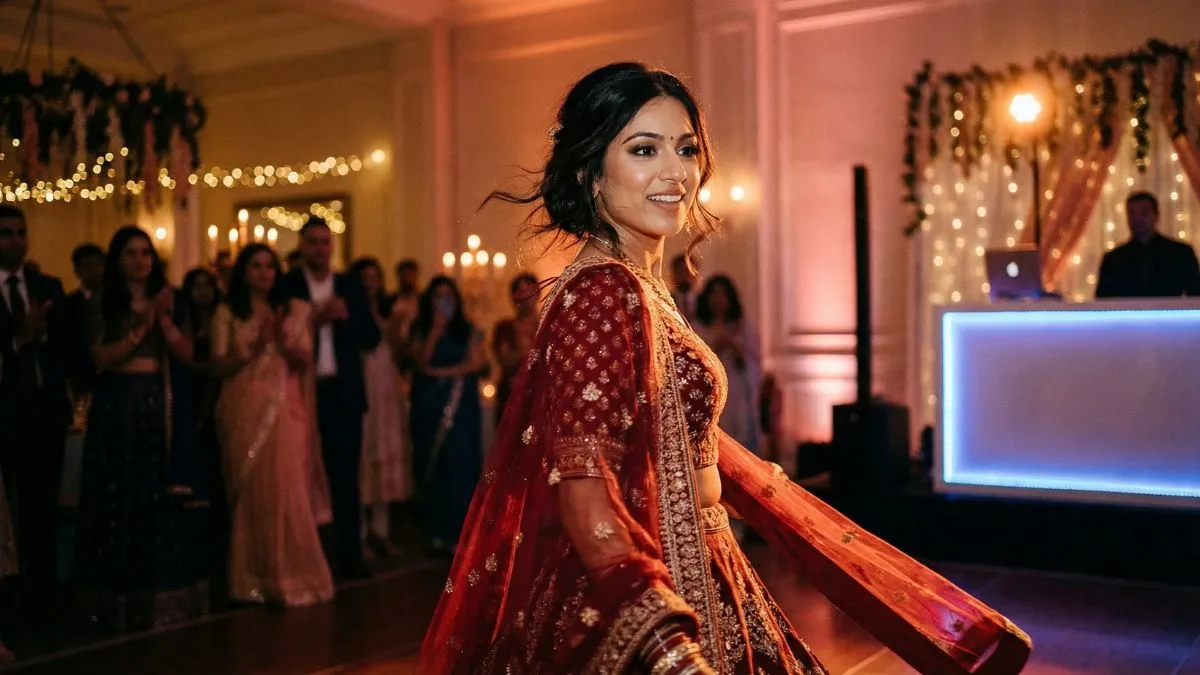
Flash Photography and Oily Skin — The Specific Problem
Flash photography creates a sudden, intense burst of direct light that reflects off the skin’s surface. How that light reflects is determined by the surface’s texture and finish.
Oily skin under flash creates two specific problems worth understanding.
Hot spots — areas of intense shine where oil reflects the flash light directly back into the camera, appearing as bright white or overexposed patches. These are most common on the forehead, nose bridge, and cheeks. They cannot be corrected in post-processing without distorting the surrounding skin texture.
Flashback — caused by SPF ingredients in some powders and sunscreens, and by certain primers, creating a washed-out or greyed appearance across the whole face under flash. This is why I use powders without SPF for setting bridal makeup, and why I have the SPF conversation with every bride at the trial.
The shimmer question
Some shimmer is appropriate — cheekbones, brow bone, inner corner of the eyes. Never on the forehead, nose, or chin for oily skin. Those areas produce their own shine throughout the day. Adding shimmer there guarantees an oily, overexposed look in every flash photograph.
The shade match problem
Oily skin can make foundation appear slightly different in photographs than it does in person — particularly under flash, where the combination of oil and light can make the face look slightly lighter or more yellow than the surrounding neck. Getting the exact shade right and testing it specifically under flash is one of the primary purposes of the bridal trial session.
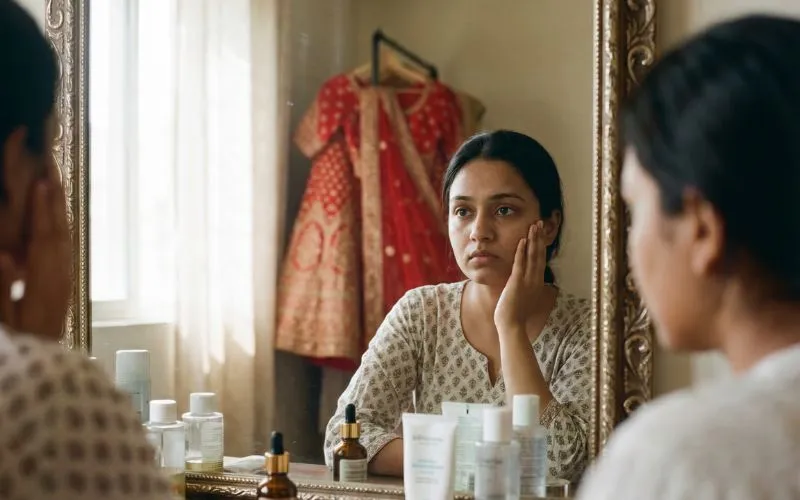
How the Approach Changes Across Wedding Functions
A Bangalore bride with oily skin is managing makeup across multiple functions. Here is how the strategy changes:
Muhurtham / Wedding Ceremony
The most critical function. Early-morning start — sometimes 4 or 5 AM — often in outdoor settings, with natural light, prolonged family rituals, and continuous photography. The early morning start is actually an advantage for oily skin — cooler temperatures mean less immediate oil production. The challenge is the duration. An airbrush is essential. A proactive blot and setting spray refresh between ritual segments keeps the look at its best.
Sangeet
The most challenging function for oily skin specifically. DJ lighting, physical dancing, high energy, and an indoor venue packed with guests all drive temperatures and sebum production simultaneously. If Sangeet is on a separate day, the airbrush base should be freshly applied. Eye and lip products always need waterproof formulas here — crying during performances and dancing are both guaranteed.
Reception
Evening function under stage lighting with intense close-up flash photography. A light blot and setting spray refresh before taking the stage keeps the base at its peak for the photographs that often become the most widely shared from the wedding.
Mehendi and Haldi
For these functions, a lighter approach is appropriate — not full airbrush, but a light, breathable tinted moisturizer or BB cream with waterproof eye and lip products. The haldi function involves turmeric on the face regardless. A heavy base here is unnecessary and uncomfortable. Save the full airbrush for the major photography functions.
Common Mistakes Oily-Skinned Brides Make
Using too much moisturizer the morning of the wedding. The number one mistake. Oily skin produces its own moisture — adding a heavy layer of moisturizer on top creates a slippery base that foundation cannot grip. A light, oil-free moisturizer applied and absorbed fifteen minutes before the artist begins is enough.
Piling on powder to control shine. The instinct is understandable. The result is worse than the shine. Heavy powder on a compromised foundation adds texture, fills pores, and creates a cakey finish that photographs poorly.
Choosing dewy or glowy makeup because it is trending. Instagram and Pinterest are full of glossy bridal looks — those are styled for controlled photo shoots, not real 12-hour weddings in Bangalore’s humidity. A dewy look on oily skin turns genuinely greasy by hour four. Matte or satin finishes photograph beautifully and last significantly longer.
Skipping the trial. This is a disaster in waiting. A trial is where the exact primer, foundation, setting routine, and shade match are tested on the actual skin, under actual heat and time pressure, with flash photographs taken to confirm the result. Without this, the wedding day is the first test — and there is no time to adjust if something goes wrong.
Not communicating the full picture to your makeup artist. I need to know how oily your T-zone gets by midday on a typical day. Whether your skin becomes shinier in the heat, specifically. Whether there are active breakouts or scarring. Whether there is a particular function that runs especially long or is outdoors. Whether you have any product sensitivities. Everything. The more the artist knows, the more precisely they can prepare.
Using a makeup artist without Bangalore-specific experience. An artist who trained in a controlled studio environment or a different city may use products and techniques that work beautifully in those conditions and fail in Bangalore’s specific heat and humidity. Local experience with oily skin in this climate matters.
Why the right makeup plan matters more than expensive products for oily skin brides
If you have oily skin and you are getting married in Bangalore, do not try to work around it or hide it from your makeup artist. Own it and demand a makeup plan tailored to your skin type. The right products and techniques will keep you looking flawless in every photo from haldi to reception.
Book a trial. Test your makeup under real conditions — wear it for 8+ hours, go outside in the heat, take flash photos at different times of day. This is the only way to know if your makeup will survive your actual wedding. Your wedding photos are forever. Makeup that slides off or looks greasy cannot be fixed in editing without making you look artificial. If you want to see how different finishes and styles work for Indian brides, read about North and South Indian bridal makeup trends in Bangalore right now.
Frequently Asked Questions
MJ GORGEOUS · BRIDAL ANSWERS
Trust MJ Gorgeous for honest bridal guidance?
Add us as a Preferred Source on Google to find more of our advice in Search and AI results.