What Is a Half Saree Ceremony? Meaning, Rituals, Outfit & Makeup Guide
Last Updated: September 8, 2026Quick Answer: A half saree ceremony is a South Indian coming-of-age celebration marking a girl’s transition into womanhood, where she wears the traditional half saree – a long skirt, blouse, and dupatta – for the first time. Known as Langa Voni in Telugu, Pattu Pavadai Davani in Tamil, and Langa Davani in Kannada, the ceremony blends a family puja, the ceremonial outfit change, blessings, and a festive gathering that typically runs four to six hours.
This guide is written for families planning a half saree function in Bangalore, especially Tamil, Telugu, Kannada, and other South Indian families who want the ceremony, outfit, jewelry, hairstyle, and makeup to feel age-appropriate and well-planned.
In fourteen years of doing makeup across Bangalore, I have stood in the room for more half saree functions than I can count. Tamil Brahmin families in JP Nagar start at 6 AM. Telugu families in Whitefield with a full-evening stage and a DJ. Kannada families in Basavanagudi are running a quiet home ceremony with thirty people. I have also styled girls for elaborate ceremonies with 200+ guests, professional photography, and drone coverage.
Each one is slightly different in ritual. Every one of them is deeply meaningful to the family celebrating.
This guide covers everything a family needs when planning a half saree function , what it is, what it means, what it is called across South Indian states, the ritual sequence, outfit and color guidance, the cost realities in Bangalore, and the makeup approach that only comes from someone who has actually been in that room.
What Is a Half Saree Function?
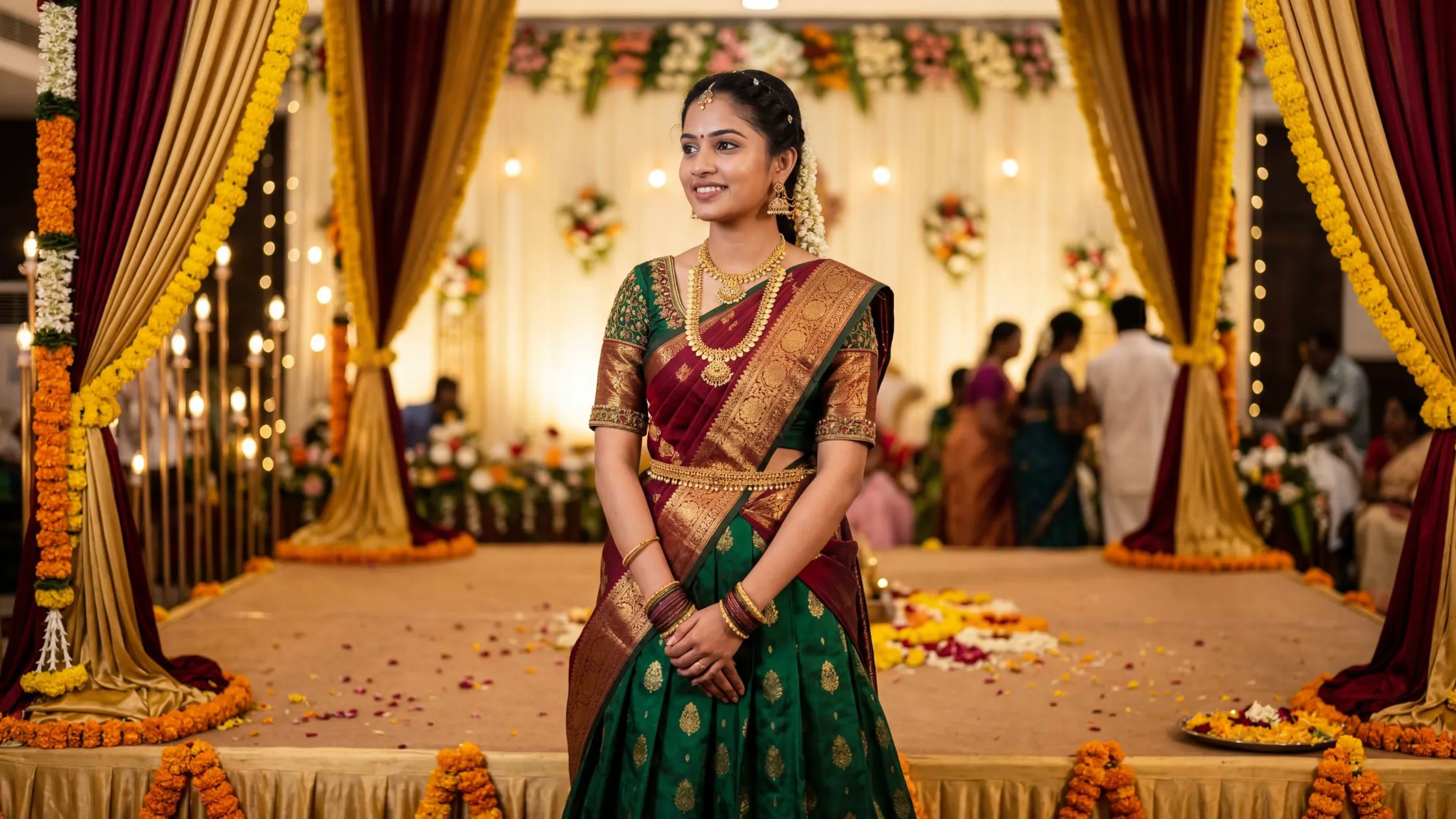
A half saree function is a South Indian coming-of-age ceremony that marks a young girl’s transition from childhood to womanhood. Most families I work with in Bangalore schedule this between ages 11 and 16. The ceremony centres around the girl wearing her first half saree , a three-piece outfit of a long skirt, blouse, and dupatta draped like a saree pallu.
The formal Sanskrit name for the ceremony is Ritu Kala Samskara (also written as Ritu Kala Samskaram) or Ritushuddhi. The event is also widely called a half saree ceremony, half sari function, or langa voni function depending on where the family is from.
In traditional contexts, the ceremony was connected to puberty and held immediately after menarche. Today, many families celebrate it as a social and cultural milestone independent of biological timing , it is a deliberate statement that says: this girl is growing up, she is being raised with her traditions, and that deserves to be celebrated publicly and beautifully.
The outfit itself is symbolic , it sits between the pattu pavadai of childhood and the full six-yard saree of married womanhood. In many traditions, the girl wears the half saree at every family function until she is married, at which point she transitions to the full saree. It is a visible, wearable marker of her stage of life.
I have worked with families who kept the function small , just grandparents and siblings in a home setting. I have also styled girls for elaborate ceremonies that rivalled a wedding in scale. Both honour the tradition. The scale depends entirely on your family’s preference and budget.
What Is a Half Saree Function Called in Different States?
This is the most frequently asked question about this ceremony because the same event has completely different names depending on where in South India your family is from. The same name can also refer to either the ceremony itself or the outfit, depending on context.
Here is the complete and accurate breakdown by state:
The same ceremony has completely different names depending on where in South India your family is from. Here is the complete breakdown by state:
Tamil Nadu
Tamil
Ritu Kala Samskara / Ritushuddhi
Pattu Pavadai Dhavani
Elaborate puja by priest, Kanjivaram silk, temple visit sometimes included. Rituals include aarti and kunkum blessings from married women.
Andhra Pradesh
Telugu
Langa Voni Function / Voni Function
Langa Voni
Maternal uncle's role is central — he presents the outfit and first saree. Vibrant colour contrasts, extensive gold jewellery, multiple outfit changes common.
Telangana
Telugu
Langa Voni Function
Langa Voni
Similar to Andhra Pradesh tradition. Rituals vary by community and district — some families include additional customs specific to their tradition.
Karnataka
Kannada
Langa Davani Function
Langa Davani
Small puja before the outfit change is typical. Karnataka families in Bangalore often blend traditional ritual with a more contemporary celebration format.
Kerala
Malayalam
Thirandukuli
Traditional Kerala Attire
Strong focus on the ritual bath and purification. Generally a more intimate celebration than Tamil Nadu or Andhra Pradesh traditions.
Assam
Assamese
Tuloni Biya / Xoru Biya / Nua-tuloni
Mekhela Chador
Assamese Hindu tradition marking the same milestone. Significantly different attire and rituals from South Indian styles — Mekhela Chador replaces the half saree entirely.
The naming confusion explained — Ritu Kala Samskara refers to the ceremony. Langa Voni refers to the outfit. But families use these interchangeably in everyday conversation — so "Langa Voni function" means the full ceremony, not just the outfit.
Bangalore specifically , because Bangalore is a city where South Indian families from every state live and celebrate, you will find all of these traditions within a few kilometres of each other. A Tamil family in Jayanagar may celebrate Ritu Kala Samskara with a priest starting at dawn. A Telugu family in Marathahalli may celebrate Langa Voni with a full evening stage and DJ. A Kannada family in Basavanagudi may hold a quiet Langa Davani function at home. The name changes, the ritual depth varies, but the meaning is the same.
Why Families Celebrate Half Saree Functions
This ceremony holds layers of meaning that go well beyond the celebration itself.
It honours rather than hides. Rather than treating menarche as something private or shameful, South Indian tradition turns it into a public celebration. The girl is dressed in her finest, placed at the centre of a family gathering, and blessed publicly by everyone who loves her. This is a powerful cultural affirmation that shapes how a young girl understands her own transition.
It connects families to their roots. For many families in Bangalore, living far from their ancestral towns and villages, the half saree function is one of very few occasions where the full weight of tradition is brought into a modern urban life. Grandmothers teach granddaughters the traditional draping style. Elders share stories and rituals passed down from their own mothers.
It introduces traditional attire gradually. The half saree is a deliberate in-between , not the pattu pavadai of childhood, not the full saree of married womanhood. The girl learns to carry herself in traditional silk and jewelry in a family context, before she is expected to wear it at weddings and formal occasions as an adult.
The maternal uncle’s role. In most South Indian traditions, the maternal uncle (mama or chittappa) has the ceremonial honour of gifting the girl’s first full saree during the ceremony. This is not merely a gift , it represents the maternal family’s formal acknowledgement of her transition and carries specific cultural weight in the extended family structure.
Living in Bangalore , where South Indian traditions mix with modern cosmopolitan life , I have seen how the half saree function connects young girls to their regional roots in a city where many grow up speaking English and studying in CBSE schools. It is one of the few ceremonies that says: this is part of who you are, and it is beautiful.
The Ritual Sequence of a Half Saree Ceremony
The ceremony structure varies significantly by community and family tradition, but most South Indian half saree functions follow a similar pattern. Use this as a planning reference , your family’s priest or elders will guide the specific ritual elements for your tradition.
The preparation , oil bath and turmeric The morning usually begins with a ritual oil bath. Sesame oil and neem-infused water are traditionally used , both have Ayurvedic significance in preparing the body for a new stage of life. Turmeric paste is applied for radiance and auspiciousness , the same preparation used in bridal traditions across South India.
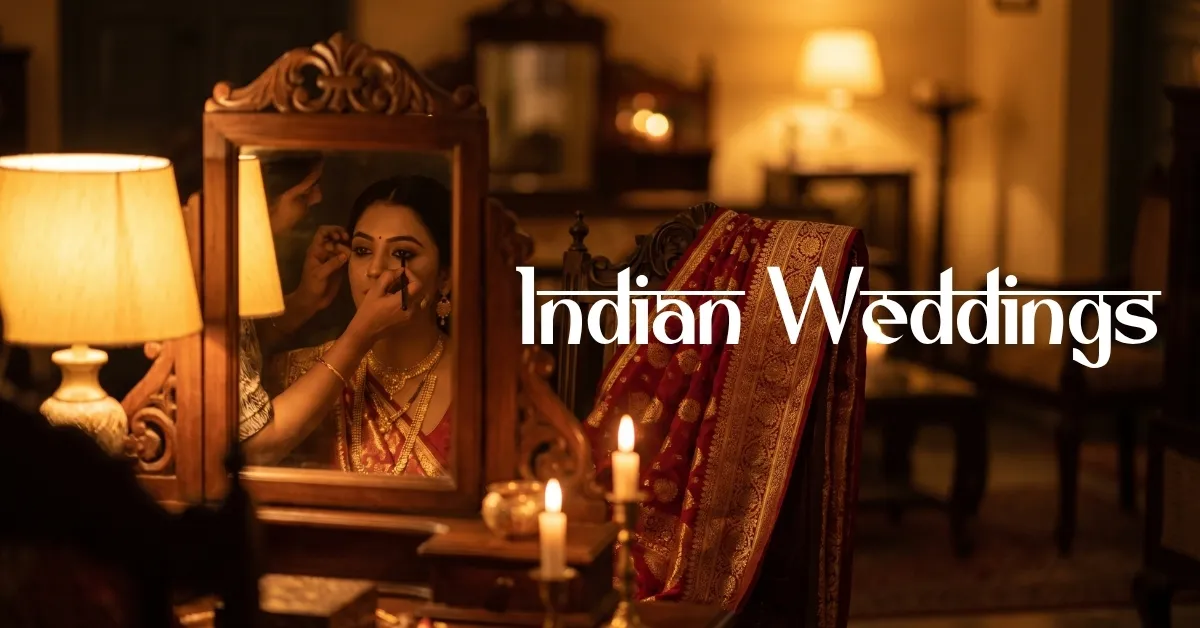
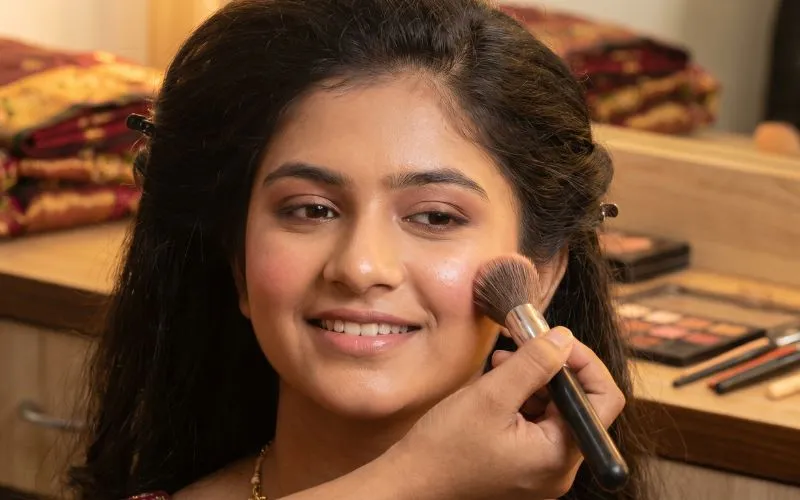
Getting ready After the bath, the girl gets ready with professional makeup and hairstyling. This is where I come in. The goal at every half saree function I work on is age-appropriate enhancement , not heavy bridal makeup. More on this below.
The puja , seeking blessings A priest performs a puja at the family altar, seeking blessings from the family deity for the girl’s health, happiness, and future. Tamil Brahmin ceremonies tend to have more elaborate, structured ritual sequences. Other traditions may have simpler blessing ceremonies. Some families include a temple visit on this day.
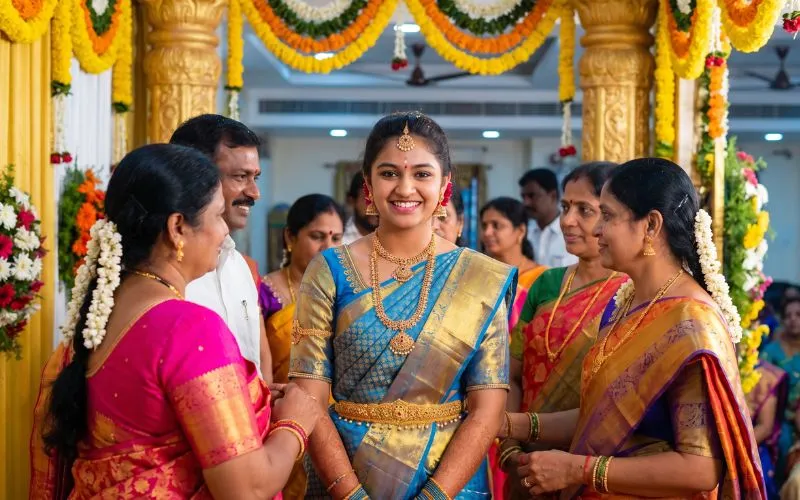
The ceremonial outfit change , the centrepiece The core of the ceremony is the girl’s first wearing of the half saree. In many families, the grandmother or most senior female elder drapes the half saree on her for the first time. In others, the maternal uncle or aunt presents it to her. Once dressed, the girl receives blessings from all the elders , who place their hands on her head, bless her with rice and flowers, and offer gifts.
Gifting Relatives and family friends bring gifts , traditionally gold jewelry, silk sarees, and cash. The maternal uncle’s gifting has ceremonial significance in most traditions, particularly in Telugu and Tamil families.
Stage photographs Modern half saree functions almost always include a decorated stage , fresh flowers, a backdrop, stage lighting , and a professional photographer. The girl stands or sits on stage for formal photographs with each family unit. This is often the longest portion of the function and the part that exhausts everyone if the timeline is not managed well.
The feast A full South Indian meal for all guests closes the function , in many families, a traditional banana leaf meal. The feast is the communal celebration, the moment when the formal ceremony relaxes into family time.
How to Choose the Half Saree Outfit
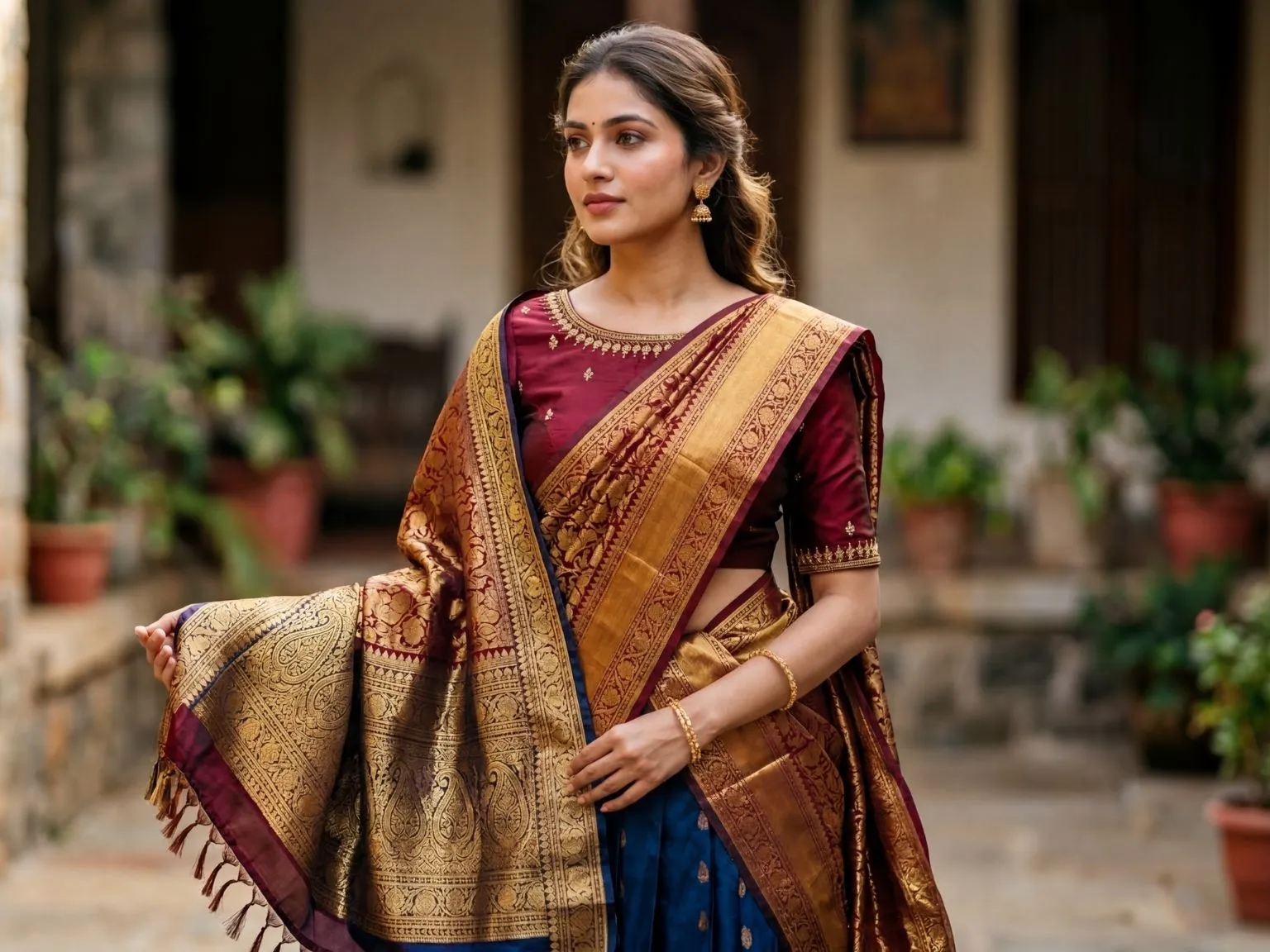
Most families choose silk , Kanjivaram, Mysore silk, or Pochampally. The skirt and dupatta are usually in matching or coordinating colours. The fit matters more than families realise. The skirt should sit comfortably at the waist. The blouse needs to fit well across the shoulders and neckline. Many girls are still growing, so order the outfit at least two months before the function to allow time for alterations.
The three-piece balance
The pavadai / langa / skirt , A full, long skirt in silk or silk-blend. The border is one of the most important styling elements. A heavy gold zari border adds grandeur. A plain border keeps the look lighter and allows the blouse to carry more detail.
The blouse , The neckline and sleeve design significantly affect the overall look. The balance principle: if the skirt border is elaborate, refine the blouse work. If the skirt is relatively plain, allow the blouse to carry the decorative weight.
The voni / dhavani / davani , The draped dupatta is both the most beautiful and the most technically challenging piece. A poorly pinned voni loosens within an hour of photographs and family interaction. Ensure it is properly pinned at the shoulder and waist before the function begins , and check it again after every outfit adjustment.
Colour Guide by State and Photography
Tamil Nadu , Deep reds, forest greens, royal blues, and rich purples with gold zari borders. These colours have been worn at Tamil ceremonies for generations and photograph beautifully under both natural morning light and indoor stage lighting.
Andhra Pradesh and Telangana , Bright, high-contrast combinations: pink with green border, yellow with red, parrot green with gold. Multiple colour combinations in a single outfit are common. These combinations produce vivid, striking ceremonial photographs.
Karnataka , More restrained palettes , deep teal, midnight blue, dusty rose, and rich purple with elegant contrasting borders. Karnataka families in Bangalore often blend traditional ritual with a more contemporary aesthetic.
Photography colour principle , Under stage lighting with flash, rich jewel tones hold their depth. Pastels are elegant in natural light but can wash out under bright indoor stage lighting. If your function is an evening indoor event with a stage setup, lean toward richer colours. Morning home functions in natural light are where pastels look their best.
The balance principle , If the outfit is very bright and heavily embroidered, keep the makeup cleaner and more minimal so the face is not lost. If the outfit is more restrained, the makeup can afford to be slightly more defined.
Jewelry That Works for a Half Saree Function
Traditional South Indian temple jewelry is the natural choice for a half saree function. Many families now choose lightweight temple jewelry specifically to keep the girl comfortable , and this is the right instinct. Heavy jewelry causes neck pain during a long function, especially for a girl who is not used to wearing it.
The complete traditional set , Long layered necklace with pendant, jimikki or chandbali earrings, bangles in gold and glass, maang tikka. A waist belt (oddiyanam) is worn in many Tamil Nadu and Andhra Pradesh families. Nose ring if the family tradition includes it.
Hair flowers , Fresh jasmine flowers woven into a braid or bun photograph extraordinarily well , the white against dark hair under warm stage lighting produces some of the most beautiful images a function captures. Artificial jasmine is a practical substitute. Coordinate the flower colour with the outfit , jasmine for red and green outfits; marigold or rose buds for more colourful combinations.
Hairstyle Guide
A braid with flowers is the most appropriate, most widely correct, and most photographed hairstyle for a half saree function. A single long braid, plaited firmly and decorated with flowers and gold hair accessories, holds through a long day, is culturally appropriate across every South Indian tradition, and photographs beautifully in both staged and candid shots.
Bun styles , A neat, tightly secured bun at the nape with flowers and hair accessories works well for girls with shorter or thinner hair.
Half-up styles , Some hair worn down in loose waves, the crown section pinned up with flowers. A popular modern choice for families who want a slightly more contemporary look.
What to avoid , Elaborate multi-pinned updos with heavy hold spray. These loosen significantly during a 4-6 hour function and become uncomfortable. A young girl fidgeting with her hair because it feels strange or tight is visible in every photograph. Practical, well-secured, and comfortable always photographs better than intricate and unstable.
Half Saree Function Makeup From an Artist Who Has Been in That Room
Most other guides on half saree functions are written by saree shops or decor brands. This section comes from someone who has stood in that room as the makeup artist for 14 years, at hundreds of half saree functions across Bangalore, for every South Indian tradition.
The goal is not bridal. Not minimal. Polished and age-appropriate.
Parents want their daughter to look special. They do not want her to look 25. The balance is genuinely tricky , and it is where many families go wrong, either by booking a heavy-handed bridal artist or by underestimating how much the lighting and photography will demand.
The makeup should enhance, not transform. When the makeup is too heavy, the girl looks uncomfortable in her own ceremony. And that discomfort shows in every photograph. After styling dozens of these functions, I can tell you with certainty , the girls who look most beautiful are the ones who look like enhanced versions of themselves.
What actually works:
Base: A light BB cream or sheer foundation , the goal is an even skin tone and a healthy glow without creating a mask. At this age, skin is usually clear and genuinely needs minimal coverage. Heavy foundation eliminates the natural radiance that makes these photographs beautiful.
Eyes: Neutral browns or soft pinks on the lids. A thin line of kajal defines the eyes without looking harsh. Heavy winged eyeliner, smokey eyes, or dramatic eye looks are not appropriate for this occasion. The eyes should look awake and defined , nothing more.
Cheeks: A natural flush that shows in photographs under stage lighting. Barely-there in person, visible in photographs , this balance is the skill.
Lips: Coral, pink, or peach shades work beautifully with traditional South Indian colour palettes. A tinted balm or sheer lipstick is often enough. Avoid dark reds, deep berries, or browns. Nothing that requires constant maintenance through a long day.
Products: All waterproof. A half saree function involves emotion , blessings, family moments, sometimes happy tears. Kajal that smudges by the first hour ruins the photographs.
Common mistakes to avoid:
Heavy baking and over-powdering create a textured, aged appearance, particularly visible in close-up photography and under stage flash. This is the single most common makeup mistake at half saree functions , and it happens when a bridal makeup artist applies bridal techniques to a completely different occasion.
A base that looks grey in photographs , the white-cast problem that occurs when the foundation has not been flash-tested. The right base should look like skin under flash, not a pale mask.
Hair accessories that are too heavy or pull uncomfortably. A girl who shifts her head every few minutes because of uncomfortable accessories looks tense in every photograph.
One thing I always tell families , brief your makeup artist specifically. Tell them it is a half saree function for a girl of this age, with this outfit, at this kind of function. An artist who does not adjust their approach from bridal makeup will get it wrong. Half saree makeup is not scaled-down bridal work. It is its own category.
At MJ Gorgeous, we offer a chargeable trial session for half saree functions for exactly this reason , testing the look on the actual skin, in the actual lighting conditions, before the day itself matters.
Common Mistakes Families Make When Planning
Treating it like a mini-wedding. I have seen families book the same vendors they would hire for a bride , heavy bridal makeup, full bridal mehendi, elaborate decorations that overwhelm a young girl. The result is a ceremony that feels too big for the person at the centre of it.
The timeline problem. Families try to fit too much into one day. They schedule the ceremony early, then expect the girl to stay in full makeup for eight or nine hours. By afternoon she is exhausted, the makeup has worn off, and the photographs from the second half of the day tell that story clearly.
Overlooking comfort. The outfit looks beautiful on the hanger but feels restrictive when worn. The jewelry weighs heavy on a neck that is not used to it. The footwear causes blisters by the third hour. Comfort should be part of the planning from the beginning, not fixed at the last minute.
Skipping the makeup trial. Families assume age-appropriate makeup is simple enough to get right on the day. But even light makeup needs to be tested for skin reactions, colour matching, and how it holds under the specific lighting of the venue. Testing beforehand always improves the result.
Starting preparation too late. This is the single most consistent problem I see. A realistic getting-ready timeline for a half saree function is:
3 hours before
Skin prep, moisturiser, begin getting ready
2.5 hours before
Makeup begins
1.5 hours before
Hairstyling alongside or after makeup
45 minutes before
Draping the half saree — always takes longer than planned
30 minutes before
Jewellery application
15 minutes before
Pre-function photographs and final adjustments
Function start
Calm, dressed, and ready
Regional Variations Across South Indian Traditions
Tamil families celebrate Ritu Kala Samskara or Ritushuddhi , the rituals include aarti, applying kunkum to the girl’s forehead, and blessings from married women. Some Tamil families combine the half saree function with ear-piercing if it has not been done earlier. The puja is typically more elaborate, and many families include a priest throughout the ceremony.
Telugu families celebrate Langa Voni function , the maternal uncle’s role is central, and many families include a separate preliminary function beforehand. The ceremony focuses heavily on the gifting sequence, and multiple outfit changes are common in larger celebrations.
Kannada families celebrate the Langa Davani function , a small puja before the girl changes into the half saree is typical. Karnataka families in Bangalore often blend the traditional ritual with a more contemporary celebration format.
Tamil Brahmin families specifically , in my experience in Bangalore, Tamil Brahmin half saree functions tend to start the earliest, have the most structured puja sequence, and place the greatest emphasis on getting every ritual detail correct before moving to the social celebration portion of the day.
Despite all these regional variations, the core sentiment is identical across every tradition I have worked with , celebrating a young girl’s growth with family blessings and the weight of her own culture behind her.
How Much Does a Half Saree Function Cost in Bangalore?
This is a question families search for and almost nobody answers honestly. Here are realistic numbers based on what families in Bangalore actually spend.
Simple home ceremony , ₹30,000 to ₹50,000 Close family of 20-30 people. The outfit, basic jewelry, professional makeup and hairstyling, a photographer for 2-3 hours, and a home-cooked or catered meal. Everything done with care but without elaborate production.
Mid-range function at a small hall , ₹1 to ₹2 lakhs 80-100 guests. A silk half saree, rented or family jewelry, professional makeup and hair, 4-5 hours of photography, catering, and basic stage decoration with fresh flowers.
Elaborate ceremony , ₹3 to ₹5 lakhs and above 200+ guests. Designer outfit, extensive gold jewelry, full makeup and hairstyling, complete videography and photography, stage decoration, drone coverage, and a catered meal for the full guest list.
Individual costs to plan around:
- Outfit: ₹5,000 for basic silk to ₹50,000+ for designer pieces
- Makeup and hairstyling: ₹3,000 to ₹8,000 for professional service
- Photography: ₹10,000 to ₹40,000 for full-day coverage with album
- Catering: varies by guest count and format
- Stage decoration: ₹10,000 to ₹40,000 depending on scale
My honest advice after working with families across every budget level – spend on what genuinely matters to your family and skip what does not. If photography is important, invest there. If the outfit is an heirloom piece, spend on quality silk. If the girl feels most comfortable with a small, intimate gathering, resist the pressure to scale up. The ceremonies where the girl looks happiest are the ones where she feels celebrated, comfortable, and completely herself , not overwhelmed.
Planning a half saree function in Bangalore? MJ Gorgeous Makeup Studio offers professional makeup and hairstyling for half saree functions, with 14+ years of experience across all South Indian traditions. Book a consultation or WhatsApp MJ Shekhar directly , she responds to every enquiry personally.
Also Read:
Frequently Asked Questions
MJ GORGEOUS · BRIDAL ANSWERS
Trust MJ Gorgeous for honest bridal guidance?
Add us as a Preferred Source on Google to find more of our advice in Search and AI results.